Credit spreads can influence a bond’s pricing, and as such are a key part of understanding fixed income. In this piece we discuss what a credit spread is and the factors that can impact their movement, and in turn, the capital price of bonds.
Introduction
There are two drivers that will cause movements in the capital price of bonds: underlying government bond yields and credit spreads. Both are equally important, although credit spreads are often less well understood.
The definition of a credit spread is the difference between the yields of two bonds that mature at the same time but are rated at different credit qualities. Government bonds are considered to be ‘risk-free’ and so they serve as the benchmark for pricing corporate bonds. When pricing corporate bonds, a credit spread will be added to the return of a government bond with the same tenor. If a corporate bond has a credit spread of +200 basis points (bps) then its yield will be the yield of the corresponding government bond plus 2%.
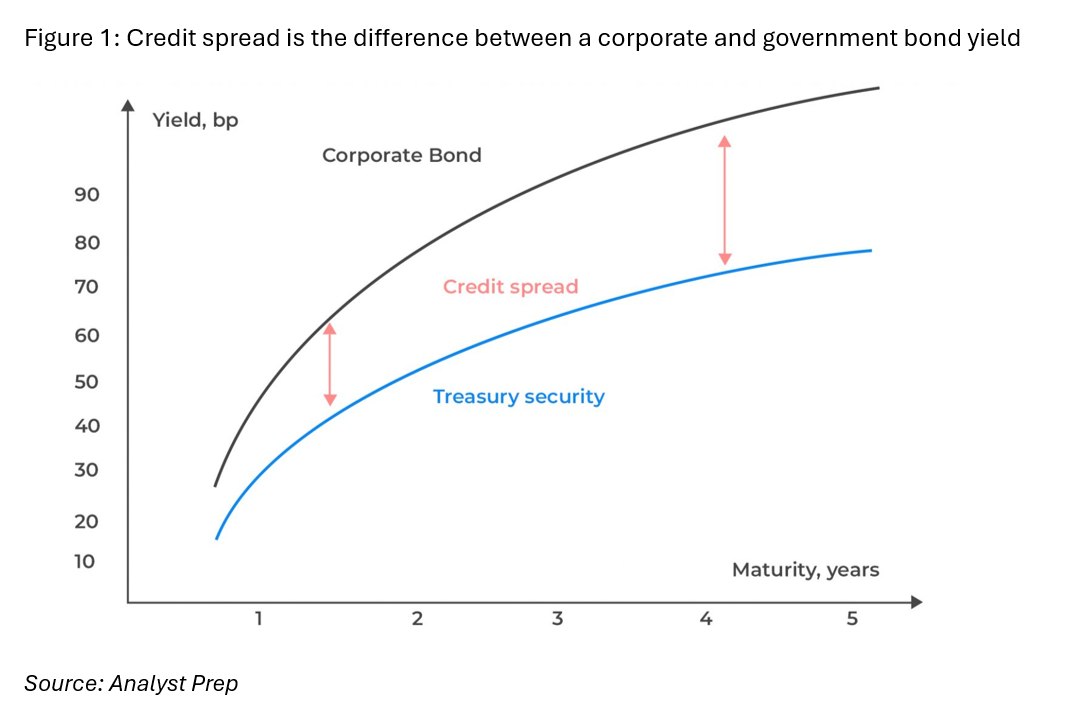
Credit spreads are influenced by a range of factors, both systematic and idiosyncratic. At a broad level, spreads tend to widen during periods of deteriorating economic conditions or weakening market sentiment, reflecting higher perceived credit risk across issuers. Company specific catalysts such as reporting poor results or a ratings downgrade will lead to widening spreads for the company’s bonds independently of broader market conditions. The primary drivers of a bond’s credit spread are its credit rating, seniority within the capital structure (ranking), and its tenor. These factors collectively determine the level of compensation investors require for bearing credit risk.
Rating
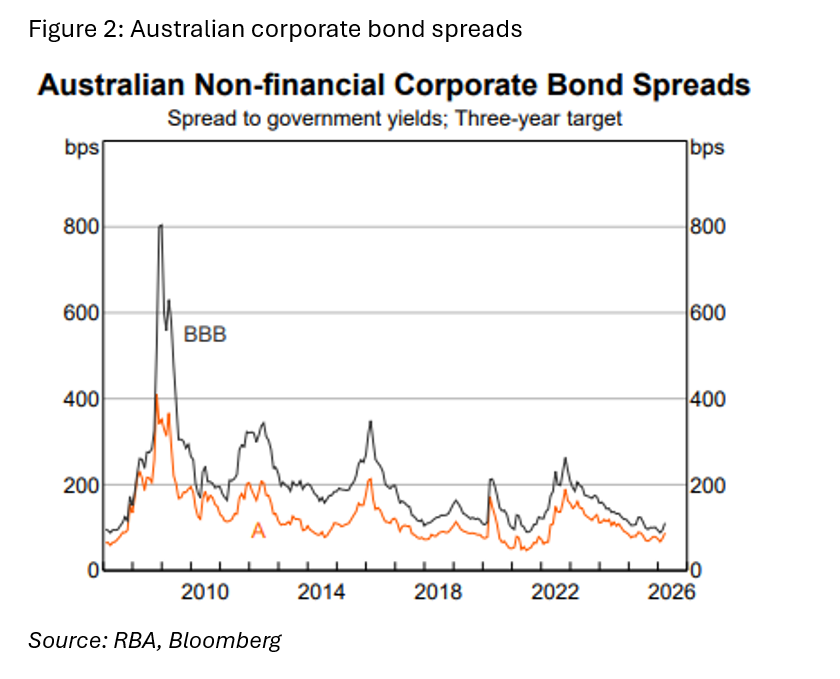
A bond's credit rating is an external review (by a ratings agency such as S&P Global, Moody’s and Fitch) of the credit risk associated with a bond and its chance of default. Because of this, there is a direct link between a bond’s rating and its credit spread. The lower the rating, the higher the bonds credit spread will be. A lower rating reflects a higher chance of default and so an investor will need to be paid a higher premium over the risk-free rate in order to invest in these bonds. When charting credit spreads, they will usually be grouped into ratings banks. The below chart is an example of this from the data that the Reserve Bank of Australia (RBA) produces and shows how credit spreads from two different rating bands move overtime.
Ranking
The ranking of a bond will also affect the credit spread as subordinated bonds sit lower in the capital stack and so investors need to be compensated for this additional risk. The capital structure of an issuer determines the order of repayments of the liabilities of an issuer should they go into default. When calculating the credit spread for subordinated notes an analyst will typically take the credit spread of the same company’s senior notes and apply a senior-subordinated multiple or spread. The multiple is not an exact science, but more of an estimate that is calculated by the dividing the credit spread of subordinated bonds, either from the same issuer or comparable issuers, by the credit spread of their senior counterparts. For example, if a Transgrid senior bond is trading at +110bps and its Subordinated notes for the same tenor are trading at +175bps then the senior-subordinated spread would be 175 / 110 = 1.59x. This can also be viewed as a spread differential (+65bps), which is useful when the high outright yield of the subordinated notes causes the spread to compress further than it typically would.
Tenor
The final component to consider is tenor, as investors must be compensated for the additional risk associated with longer maturities. Interest rate duration is the most commonly referenced measure of duration, but investors should also consider credit duration, which reflects the exposure of a bond’s spread to changes over time. The greater the credit duration is, the more sensitive the bond’s price is to movements in credit spreads. For this reason, there will typically be an upward sloping credit curve as tenor increases but this will usually plateau towards the longer end of the curve. When assessing relative value, analysts will typically add a spread (i.e. 10bps) for each additional year of duration. This will differ depending on which part of the curve the bond sits and the convexity of the curve at the time.
Credit indices
A portion of the movement in credit spreads will be due to systematic factors that will move the credit spreads of most bonds in certain regions. These factors can be macroeconomic conditions, market sentiment, liquidity and volatility. Credit indices such as CDX and iTraxx are used to track these movements. These are standardised financial benchmarks that measure a basket of bonds to show the movement in credit spreads across a region or sector. These can be thought of as similar to equity indices such as the ASX 200 or S&P 500. The main credit indices in the US are CDX Investment Grade and CDX High Yield. The high yield benchmark will typically be more volatile than the investment grade benchmark as the bonds have a lower rating and are inherently riskier. The primary index for Australia is iTraxx Australia which tracks 25 equally weighted investment grade entities.
Analysing relative value using credit spreads
We will often discuss relative value (RV) in terms of outright yields as this is easier for many investors to understand, however institutional investors will look at credit spreads. When analysing RV in this way, the primary considerations are the ranking, ratings band and tenor of the new issuance. The comparable bonds used in an RV chart should be the same ranking (senior or subordinated) and of a similar credit rating. Comparing a subordinated issuance with senior bonds or a high yield bond with investment grade bonds would not be useful and could lead to an incorrect estimate of fair value.
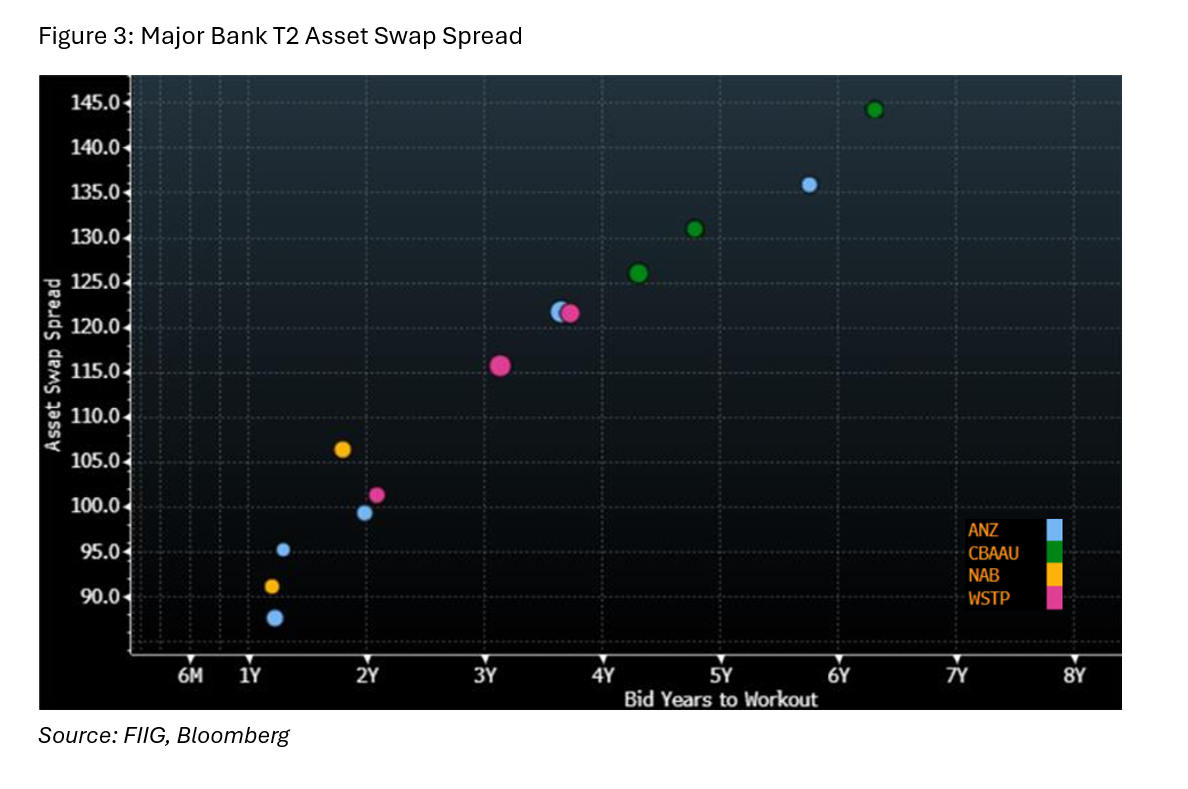
Once comparable bond selection is complete, these should then be plotted on a chart that has tenor on the x axis and spread on the y axis. If you imagine a line of best fit through these data points, this will provide an estimate of relative value for bonds issuing at any tenor across this curve. An example of this has been charted below using major bank T2.