Following the recent release of the FIIG Macro Outlook, here we discuss the RISE strategy and how best to construct a fixed income portfolio for the year ahead.
Background
On 14 January, FIIG published the quarterly macroeconomic outlook report (click here) which also included our annual strategy piece. In 2026, our strategy is titled RISE in an acknowledgement of the likelihood of a Reserve Bank of Australia (RBA) rate rise at some point in 2026.
Our conclusion in the RISE publication itself was that the data in January would need to be actively arguing against a rate rise in order to convince the RBA not to move rates higher. In the two weeks since publication, the data has been stronger than generally anticipated and suggests a rate rise is more necessary, not less. The unemployment rate fell unexpectedly from 4.3% to 4.1% in the labour force data released on 22 January while the CPI data released on 28 January showed Inflation was slightly higher than anticipated – and much higher than the RBA’s target band of 2-3%.
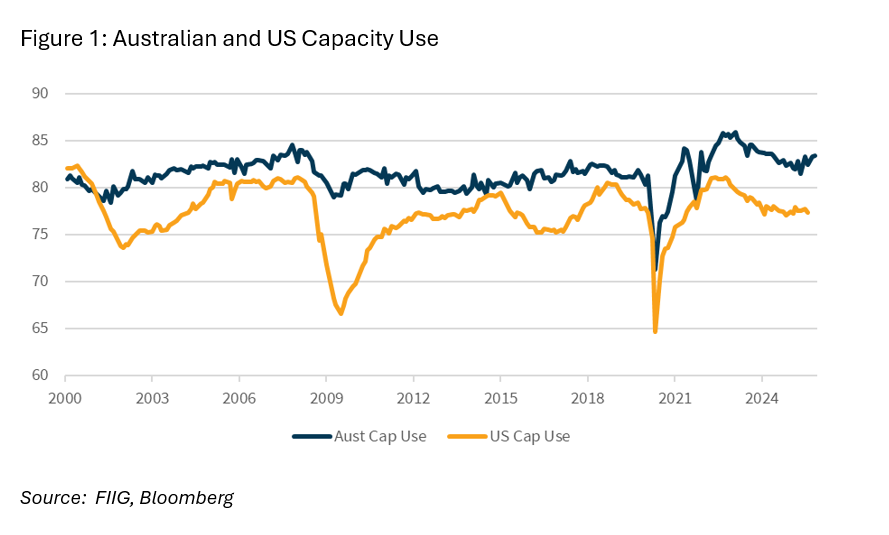
It’s reasonable to ask how the general expectation and market pricing went from rate cuts being seen as far more likely in mid-late 2025 to rate hikes being seen as very likely in early 2026. This was the key theme in the RISE publication. The short answer is that the RBA’s decision to only raise rates gently in 2022 and 2023 has created a lovely soft landing for the Australian economy. Rather than a boom followed by a bust, we’ve had a boom followed by a gentle slowdown. But gentle slow-downs don’t create spare capacity in the same way that large busts do. Capacity use is higher now than it would normally be in a rate cutting cycle.
Macro Outlook
Given the lack of spare capacity, when the Australian economy hit some improvement in late 2025 there was not much spare capacity. Total demand was already near total supply and the improvement in demand caused inflation to begin to materially rise.
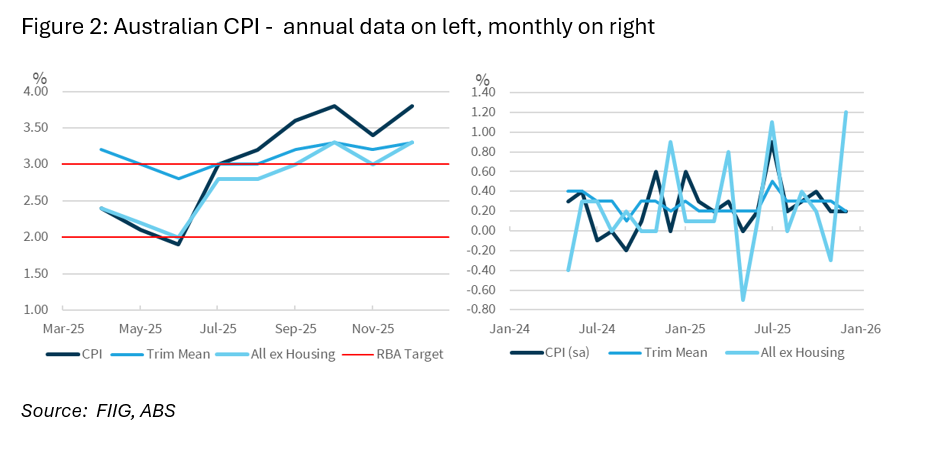
This rise in inflation was already looking ominous when we wrote the Outlook and the more recent data looks even worse. The CPI data is hard to interpret too finely at present, but it doesn’t look good. The recent change from a quarterly series to a monthly one makes it hard to get our bearings. However, sometimes we don’t need to put too fine a point on it. The current annual CPI rate is between 3.3% and 3.8%, depending on exactly which measure you use. The RBA’s target is 2.50%, which is the centre of the target band of 2.00-3.00%. Taking a step back it’s easy to see that inflation is too high, even if the exact drivers and the exact timings are not as clear.
The monthly CPI rise of 1.0% in December for 3.8% on the year in headline terms, or 0.2% on the month and 3.3% on the year in trimmed means is simply much too high. The quarterly trimmed mean, which came in at 0.9% and 3.4% for Q4 and the year, respectively, doesn’t really tell a different story. Inflation is too high whichever way you look.
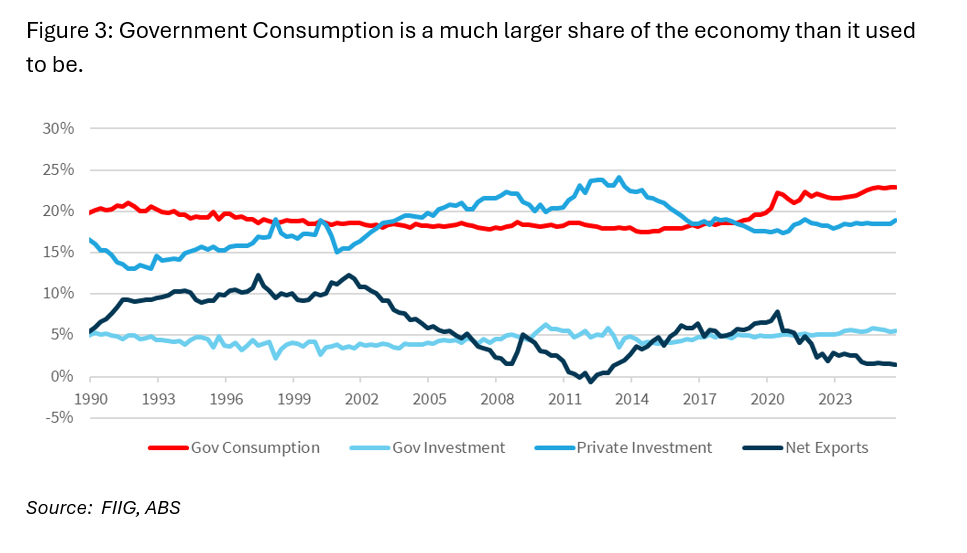
In the RISE strategy, we discuss the fact that, much like the mouse in the famous Pamela Allen book Who Sunk the Boat?, it’s not always the most recent development that “causes” the outcome. The recent rise in demand from household spending is there, but comparatively small, while the rise from demand from Private Investment into technology is also present, but comparatively small as yet. So, if the rise in household demand and private investment are both quite small, who used the spare capacity? The answer is, largely, the government did. Over the period starting in about 2015, Government consumption as a share of the economy rose materially.
So, with apologies to Pamela Allen:
Was it the Households struggling with cost, who just kept afloat when it felt all was lost?
Was it the Net Exports, wilted and sore, who were nervously eyeing another trade war?
Was it the Government Investment feeling 70s and retro, chuffed and excited with a lovely new metro?
Was it the Government Consumption large and unending, hurtling upward and scarily trending?
Was it the Private Investment, the last to get in, the smallest of all, could it be them?
You do know who used the spare capacity!
We have household consumption growing because of rate cuts and private investment rising because there are solid opportunities to improve productivity with investment. But these new spending forces have hit an economy with very little spare capacity. As such, they’ve created inflation. This renaissance of inflation has seen the RBA swing from being moderately dovish to quite hawkish very quickly. They’re likely to raise the rate in February and, if they don’t, they will certainly be very hawkish and laying the groundwork for a rate rise in coming months.
RISE Strategy
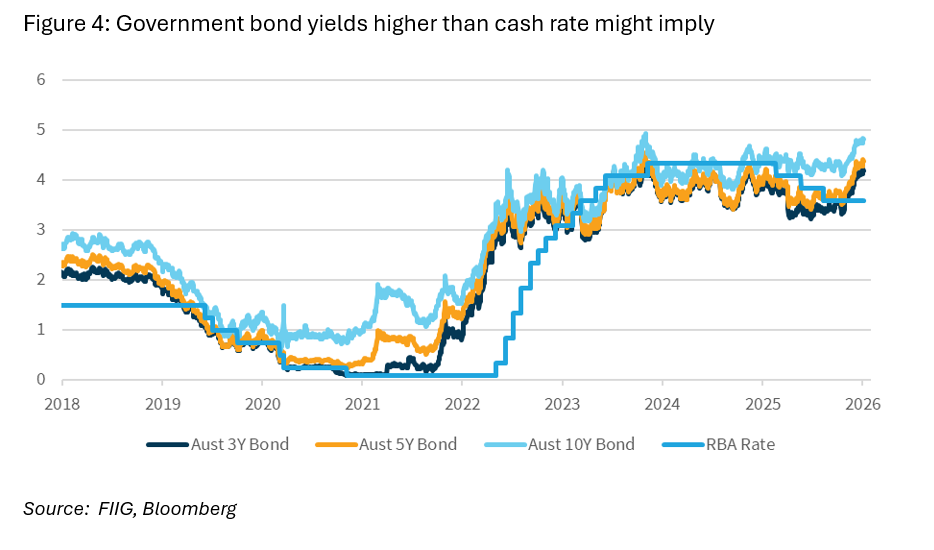
Bond yields have already reacted to the increase in RBA expectations and are now very high. In fact, the government bond yields are higher now than they were when the cash rate was 4.35%. The current market pricing is an expectation of rate rises to a peak of 4.17% by the end of the year, which is more than two rate rises from here, but notably less than the previous cash rate peak. Bond yields are much higher now than they were for most of the period of 4.35% rates, though.
Given the very high returns on offer now from bond yields, we find the potential returns in fixed income to be very attractive. However, there are still many risks around too. Our RISE strategy is, fundamentally, to take advantage of the returns while paying attention to the risks.
R Returns. Returns will be high for long-term investments. The market is assuming a decent period of rate rises, which may or may not occur, but will likely see periods where solid yields of 6% and more are available for low-risk bonds.
I Inflation Protection: This can be either direct, via inflation linked bonds or IABs, or more indirectly via the floating rate note market, which will benefit if inflation and cash rates rise together.
S Sector Diversification: There are quite a few pressure points in the economy. It is also likely that some sectors will come under pressure as the RBA seeks to raise rates to create space in the economy. It’s hard to predict where the contractions will come to make that space, so diversification is important. Credit spreads are relatively tight, so you need to make sure you are not overly exposed to any one sector.
E Exchange rate exposures. If the RBA is raising while the rest of the world is cutting, there is a chance of substantial volatility in the exchange rate.
In the RISE document we highlighted that there was a material risk the exchange rate shifted dramatically after a period of stability. Since then, the currency has shot up to over 70 US cents. That makes now a comparatively good time to make investments overseas, but the currency is likely to be volatile in the future.
The other reason that the AUSUSD exchange rate might be volatile is the US side of the equation. The self-destructive policy of the US in many areas is seeing larger global companies seek to establish borrowing programs in places that aren’t the US. Since the Japanese election was called the instability in the Japanese yields has also suggested that maybe Japan is not the way to replace the US holdings either. A large number of global companies have been choosing Australian dollars. This is making the Australian bond market larger, more liquid and deeper than it was before. This has benefits both in the form of global companies coming to Australia (as EDF, UBS and more did last year) but also in allowing Australian companies to stay at home when issuing more complicated products (as AusNet has done this week by using AUD markets to replace an existing EUR hybrid bond).
2026 is going in a different direction than we expected as recently as mid last year, but there are opportunities for solid returns in bonds, even with the prospect of an RBA rate rise.