The war in Iran is causing reverberations around the world. Locally, the largest effects are coming from the volatility of the oil price. Equity prices have been highly volatile while bonds have managed to keep some stability, even when they’ve fallen too. Here we look at the recent geopolitical events, and key considerations for investors.
Understanding the Geopolitics: What counts as success?
The war in Iran began just over a week ago. There was very limited discussion beforehand of the aims of the war, which makes it very difficult to assess what success looks like for the United States.
The best way to understand the US position that we saw came from reading the statements of Pete Hegseth. It’s a confronting read, but the way he described the war as an exercise in power is key to understanding the new paradigm of US military engagement:
He [Trump] called the last 20 years of nation-building wars dumb, and he’s right. This is the opposite. This operation is a clear, devastating, decisive mission: destroy the missile threat, destroy the navy, no nukes.
We’re hitting them surgically, overwhelmingly and unapologetically. America, regardless of what so-called international institutions say, is unleashing the most lethal and precise air power campaign in history.
All on our terms, with maximum authorities. No stupid rules of engagement, no nation-building quagmire, no democracy-building exercise, no politically correct wars. We fight to win and we don’t waste time, or lives.
US War Secretary Pete Hegseth, quoted in The Age, Trump won’t rule out boots on the ground, 3 March 2026.
As is clear from Hegseth’s statements, the US didn’t set out to build a new regime in Iran; they set out to take out the previous one and to demonstrate that they could. That has already been achieved. Trump has made statements about how far ahead of schedule the war is, which looks rather a lot like groundwork to simply declare success and then stop fighting.
The US is caught in a bind that, although they have the military hardware and the manpower to completely destroy Iran, they do not have the political will to do so. Trump refuses to put boots on the ground for the very understandable reason that boots on the ground means casualties and likely a large number of them. But being unwilling to put boots on the ground makes it very difficult to effect regime change. You can cause regime removal using only airpower, but to build something new from the ground up requires, almost always, literally, boots on the ground. The recent experience in Venezuela seems to break that rule – but it’s worth thinking about why. In Venezuela, there was a faction within the existing government that was friendly to the US. The US military came in and removed Maduro, allowing the US-friendly Delcy Rodrigues to claim power. This makes the whole Venezuelan experience thing look more like a state-sponsored coup than a war. It was a single-night operation, after all. But the success in Venezuela seems to have given some in the US the wrong idea about how easy it is to change regimes in other places. We’re not convinced that the Trump administration ever wanted to do that, but some of the people they convinced to go along with the war were likely influenced by the success in Venezuela.
There is no pro-US faction in the Iranian government, and while the Iranian Revolutionary Guard might be massively outgunned by the US military, they, in turn, massively outgun any of the pro-democracy elements inside the country. There are very limited prospects of a street uprising being successful while the Iranian regime has both regular guns and the will to use them on unarmed protestors. As seen as recently as last month, the Iranian regime does have both of those.
Which basically means the war is something of a stalemate on the military side. The US and Israel can continue to bomb Iran, and Iran can continue to send drones and missiles against other countries, but neither side is going to achieve much from that. President Trump has already said he thinks the war is “pretty much complete,” which suggests he is looking for an exit he can claim as a victory.
Iran’s relative military impotence does have one counterpoint. Iran has had much more impact by using economic weapons than military ones. The Strait of Hormuz is a narrow shipping lane through which a huge proportion of the world’s oil and petrochemical products are shipped. It is located, physically, on Iran’s Southern border. Because of the geography, most of the oil that leaves Iran, Iraq, Kuwait, Bahrain, UAE, Qatar, and Saudi Arabia does so via this shipping channel. By threatening to block the channel, Iran caused the price of oil to spike incredibly high (see Figure 1).
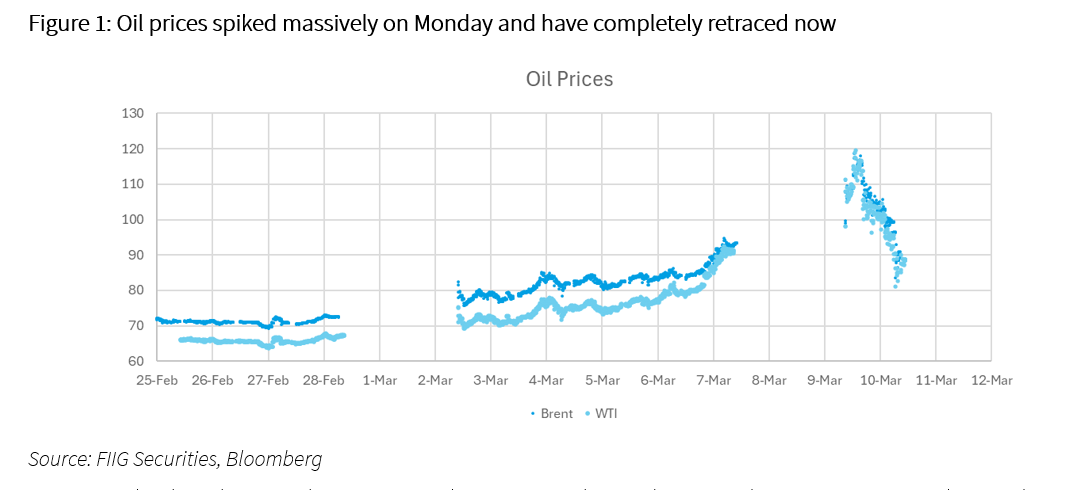
In turn, Iran has been lowering the temperature by suggesting they might reopen the Strait to countries that expel US/Israeli diplomats. We doubt that’s actually a solution and we doubt many will take them up on it. But it does seem to suggest that both sides are looking for face-saving offramps. The oil prices have already fallen back dramatically after Monday’s absurdities. As odd as it sounds to say this, the war might well be over in a matter of hours or days. Though, as always with war, things can get destabilised very quickly.
Understanding the Markets: What changed during the war?
The fact that the war might end quickly doesn’t mean it didn’t have an impact, both short-term and long-term. In the short-term, we have had material volatility in both equity and bond prices. However, what those two markets mean by “material volatility” is worth exploring further.
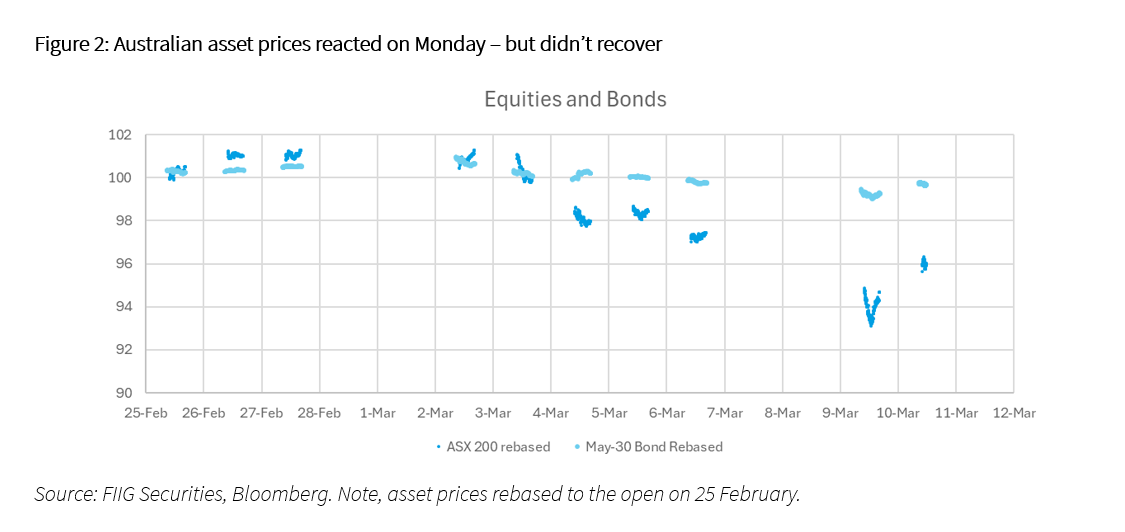
The Australian equity markets had a peak-to-trough drop of 8.08%. By contrast, the Australian May-30 Government bond dropped 1.92%, peak-to-trough. (Note, we use the May-30 since it has a duration of 3.8 years, the same as the FIIG portfolio overall).
Even though the spike in oil prices has almost entirely reversed, the damage to asset markets remains. Both bonds and equities bounced back somewhat on Tuesday, but are both well short of fully recovering from Monday’s fall. (Ain’t that a metaphor for war: the fighting may stop but the damage is done.) But we shouldn’t lose track of the relative volatility, either. Those who sought protection in bond markets did largely achieve the aim: there was a mild change in the bond price, but nothing like as large as the fall in equity prices. See Figure 2.
This is a major reason why many FIIG investors bought bonds in the first place: they were seeking an investment that wouldn’t be nearly so affected by unexpected ructions in markets. However, the success of bonds was qualified – there are some bonds that have done well while others have not done as well. They were still a strongly performing defensive asset, however.
Understanding the lessons for the future: What might have changed for good?
If this is right, and the global geopolitical order has changed for good, then it will come with some long-term lessons for investors. Here’s our understanding of what investors should have learned from the last few days.
Lesson 1: The world is more volatile, and going to stay that way
The calm considered growth of the past is no longer likely to continue. While the world worked slowly towards trade deals and mutual understandings, these flare-ups in violence were rare. I fear that the US is now, as Hegseth’s words suggest, going to use violence as a tool of foreign policy far more frequently and with far fewer reservations. That will make for more risk everywhere – including financial markets. That suggests that bonds need to be part of investment portfolios since they are far less volatile. But it also means that we ought to be taking care with the particular type of bonds chosen. In our RISE outlook, we discussed the need for floating rate notes to protect portfolios from duration risk should interest rate structures change materially. The increasing use of violence as a global medium will create risks that inflation will rise further.
Lesson 2: Be careful of the correlations between assets – you need more diversification than you think you do
The standard correlations between assets can weaken in extreme circumstances. That’s what happened on Monday when bonds and equities both fell. We don’t infer from that diversification doesn’t work; instead, we infer that when most assets are going one way, things that are highly diversified in regular times become only partially diversified. The lesson is to have more diversification than you think you need because in large moves, everything tends to move together. For bond market investors, that means you ought to be paying attention to diversification at all levels. That means having both bonds and equities, but also having different sorts of bonds like fixed, floating and inflation linked in your portfolio.
Lesson 3: Inflation trauma is real for markets – and economies
Past experience has shown, an outbreak of inflation from an external source was treated as an external event that the RBA would “look through”. This was emphatically not what has happened in the past week. The rise in oil prices is an external event, but with inflation already “out of the bottle” as the saying goes, the market reacted in a very different way. This is probably reasonable. When inflation is already free in the system, it’s much easier for sellers, particularly service providers, to raise prices. Price rises are already expected and so create far less consumer pushback. There’s a form of inertia when prices are stable and a form of momentum when prices are already moving. Because prices have been changing frequently in Australia of late, it’s easier to provoke them to change again or to raise them by more than previously planned since they were going to change anyway.
Lesson 4: The world is getting less safe – Governments and Central banks will have to respond militarily and economically
Tuesday morning, it was announced that Australia is sending some specialised anti-drone aircraft to help protect some of the Gulf from the Iranian drones. That’s a very concrete example of a risk we’ve been pointing to for some time. Namely, that the military ramp-up of the Trump era would involve larger military spending for everyone, everywhere. Theoretically, that could be done by reapportioning spending without being inflationary. However, that seems unlikely. Even if some of the spending is offset from other places (or tax increases), it seems fairly likely that the spending will be at least partially larger.
But that’s only one prong of the appropriate government response. There are likely policy types in Canberra thinking about how to stiffen Australia’s borders in a physical sense and in an economic sense. Do we need a larger strategic oil reserve? Do we need greater non-carbon energy production? Do we need to bring military production onshore even if it’s not the cheapest? Do we need to consider who we sell some commodities and items to? (Currently, a surprisingly large portion of the Iranian Shahed drones are built with American parts.)
The answers to these questions aren’t clear, but from an economic perspective, they all lead to the same conclusion: the Government may choose economically sub-optimal arrangements because of the greater security they provide. But economically suboptimal is another way of saying low productivity. This is the flipside of the peace dividend. For decades, Australia and the world have reaped benefits and productivity from peace. We’re going to need to pay the price now, and the price will likely be inflationary, with the attendant risks that the RBA raises rates.