The February reporting season concluded recently. Below is the collected thoughts of the FIIG Research team who spent much of the month analysing the results of various companies. These results all predate the war in the Middle East, of course.
Introduction
The February reporting season was strong across most sectors with above average earnings beats. There were industry specific themes but also underlying thematics across all companies. Share buybacks were a theme of this reporting season which is a factor of higher profits but also suggests there are less attractive investments for management to use this cash on. The payout ratios were also fairly large which is not ideal for bond holders, however, it is justified in periods of strong profits. AI continued to be a theme mentioned across most sectors. It was discussed as both an area of spend in the short term and a pathway to reducing costs and increasing efficiency over the longer term.
Consumer-Facing Corporates
With ongoing cost of living concerns, consumer-facing companies were focussed on cost and productivity efficiencies with the ability to then pass this on to the end customer. From consumer staples to air travel, value was front of mind for households. Coles and Woolworths reported top-line growth but commented on how ‘value seeking’ their customer base was. This theme was echoed in the Qantas result as their lower cost carrier, Jetstar, was the outperformer. This was yet another example of the two-speed economy that we have discussed, where overall economic activity is overheating but the consumer is rather weak (see the RISE Macro Outlook from January for more on this). There have been two rate rises so far this year which will only increase the strain on the consumer. There is mounting pressure on the government to address their level of consumption in their upcoming budget in order to reduce the current capacity issues.
Banks and Non-Bank Financial Institutions
Banks and non-bank lenders continued their strong performance but faced increasing competition to grow their loan books, which could lead to growing risks if they lower credit standards in an attempt to win market share. Heightened competition combined with the Reserve Bank of Australia (RBA) cutting rates in 2025 had put downward pressure on Net Interest Margins (NIMs). The market’s interest rate expectations have shifted dramatically since December and the higher rates in the second half of the financial year should be beneficial to bank NIMs. CBA’s NIM was the highest of the majors at 2.04% while ANZ was the weakest at 1.56%. ANZ is in a different position to the other banks as it is going through a large transition period after acquiring Suncorp bank. ANZ may have one of the higher cost-to-income ratios and weakest NIM, but the bank has made good progress on their cost cutting measures which should be supportive for profits going forward.
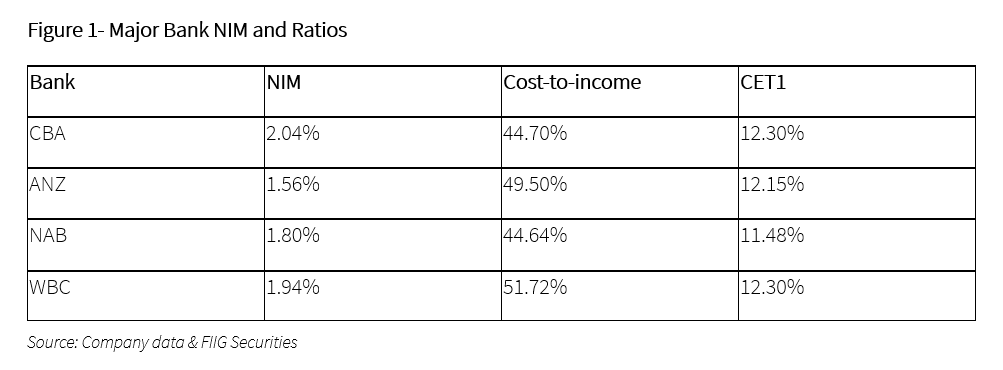
Riskier behaviour has reportedly increased due to growing competition among lenders. This includes providing low-doc borrowers rates that are similar to prime borrowers, removing clawbacks from broker agreements and lower verification requirements. Whilst these practices are more evident among the smaller non-bank lenders it does increase the risk of defaults which is a negative for the whole sector. This will be something to watch as we progress to the later stages of the credit cycle. For the major banks, there is no evidence of increased risk‑taking, though the competitive pressure may weigh on profitability.
Utilities
In the Utilities sector, one of the most common themes was the growth opportunity that datacentres provide. It has been well publicised that these facilities will require large amounts of energy but we are starting to see the increased demand feature significantly in capex plans for utilities. Well-capitalised hyperscalers such as Google, Meta and Amazon are taking up contracts for entire datacentres themselves and locking in energy contracts required to operate these facilities. Another area of spend is batteries which are a key requirement for the renewable energy transition. Origin and AGL both mentioned their spend on batteries with Origin committing $80m to a battery project this year. The scale of these batteries varies from servicing small areas to serving the entire grid. The larger scale batteries are expensive due to their size and the requirement to purchase land close to the grid. Batteries are essential to the transition to renewable energy because they bridge the gap between when energy is generated and when it is most needed.
REITs/ Property
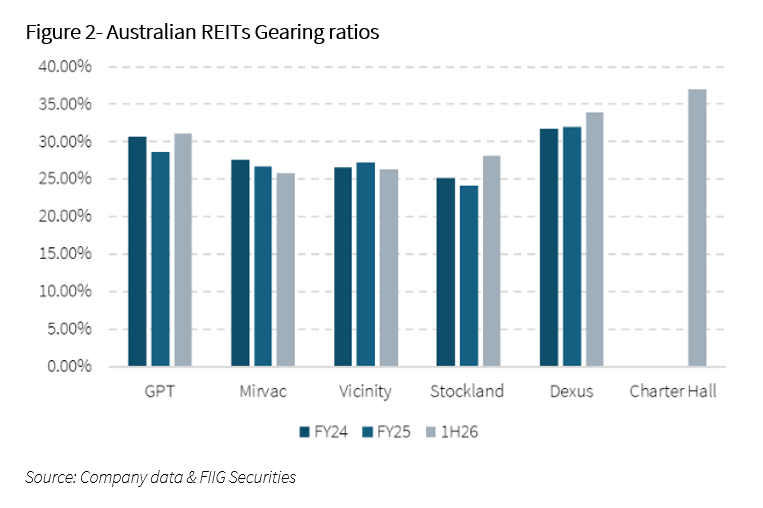
With an overall improvement in asset valuations over the period, the Australian Real Estate Investment Trust (REITs) showed momentum in its recovery in the sector. This sector had been plagued by building disruptions, cost blowouts and the unknown surrounding hybrid working, but these concerns have now mostly stabilised. Interest rates were a tailwind in 1H26 but they may now become a headwind due to the significant change in the RBA’s outlook. While the Office segment lagged the rest of the portfolio (Retail and Industrial), most REITs continue to divest from lower graded office assets in favour of prime or even premium office space. The latter has seen stronger demand and a faster recovery compared to secondary assets. While credit metrics across the board were mostly stable or had improved, some noted an increase in gearing levels as they accelerated developments and timing of settlements fall in 2H26. The rate outlook has changed significantly since the end of the half, but most companies talked down the impact the first rate rise would have.
Insurance
Results in insurance were mixed among different companies largely split by whether or not the company fully offsets their risk via reinsurance or not. Companies that did fully reinsure themselves did very well, while companies that were still holding extreme event risk on their own books were hit hard by storm events in Queensland. Suncorp had their profits hit by one of the worst halves of natural disasters in recent history, with nine natural hazard events in the half which had a total net cost of $1.3bn.
Conclusion
In our view and only emphasized by the 1H26 reporting season, bond investors should continue to prioritise diversification. The overall market remains strong, but there are a lot of external pressures. Those pressures will eventually show up in weaker performance, but it’s not clear where that weakness will show just yet. A well-diversified portfolio should be able to avoid the worst of any unexpected developments.
Some of these risks such as the repricing of the RBA rate outlook was discussed in many earnings calls but the Iran war unfolded towards the end of the reporting season, and certainly after the 31 December 2025 accounting period. We may see weaker 2H26 results due to changed market conditions and investor/consumer sentiment from the conflict. Air New Zealand is one company that has already pulled their FY26 guidance as a result of the conflict. The conflict and associated inflation spike will likely be key areas of comment in the full year earnings calls later this year.