Controlling inflation is not just about controlling price rises, but also the expectations of future price rises. That’s what makes an oil price shock so dangerous for the RBA. They raised rates in March because of the war, in our view.
The RBA has raised rates a second time in consecutive months
The inflation rate was too high – everyone knew this – and the RBA has chosen to raise the cash rate to 4.10% at their 17 March meeting. The decision was far from unanimous, and the final vote was 5-4 in favour of raising rates in March.
The RBA Governor, at the post-meeting press conference, argued that it was only a matter of timing. The majority of the Board felt that a rate rise should be delivered now. The other four members felt a rate rise could wait until the meeting in May.
The sequencing of rate rises is very difficult for a Central Bank. The RBA effectively has two contradictory things it needs to achieve. It needs to get out in front of inflation expectations by raising rates well ahead of inflation becoming a problem, but it also needs to wait to see how much each rate hike affects the economy before moving again so as not to raise rates too far and trigger a downturn (or worse, a recession). It’s a pure ‘catch 22’. The RBA needs to be before expectations have moved but after the data is released and they can’t be both. Instead, the RBA must weigh up the various risks at any given time. Managing that inherent contradiction is not an easy task at the best of times.
This is far from the best of times. Australia’s economy was delicately poised from a purely domestic viewpoint in February. Overlay the war in the Middle East in March and you have a very difficult situation to analyse. Central banks usually try to look through energy shocks when they are temporary causes of inflation, however this is much harder to do when inflation has been above target for a number of years already because the interaction of inflation and inflation expectations means short-term rises in inflation from oil prices might not be as temporary as hoped. Certainly, while some resumption of oil trading through the strait of Hormuz is possible if Iran decides to agree to the US proposal, it won’t be back to where it was for a very long time, if ever.
Impact of the Iran War
We strongly suspect that if the Iran War had not begun, the RBA would have been able to wait until May to raise rates again. Yes, it’s true that there is enough of a signal in the domestic data that the RBA probably needed to raise rates again at some point but the timing was different. The inflation rate was very high at the last print being 3.8% headline and 3.4% trimmed mean for the monthly result in January. The impact of the electricity subsidies is there, but there is more to it than that. The trimmed mean is also clearly above the 2.50% target and rising. At the same time, the unemployment rate was only 4.1% at the time of the meeting, which suggests a strong labour market. With unemployment low and inflation high the RBA was always going to be forced to raise rates again, the only question was when.
Before the Iran War, the RBA was choosing between raising rates in March and in May. When considering March, the attraction for the RBA is that you have the advantage of going earlier and getting in front of inflation more. You appear decisive and that is helpful in of itself. If inflation is going to be a problem you can confirm your credentials as an inflation fighter by raising rates quickly. However, you also run the risk of raising rates more than needed and damaging the economy more than necessary. If, instead, the RBA had waited until May, the RBA would have been able to see more inflation data (including the Q1 quarterly result) and see how the first-rate rise had begun to affect the economy. The RBA was also (previously) of the view that a decent part of the recent spike in inflation was temporary. There’s no guarantee, but the need to see the real data has often kept the RBA to raising rates only slowly and that’s why we suspect that, in the absence of the Iran War, the RBA would have waited until May to raise rates. The decision was 5-4 so it wouldn’t have taken much to change the outcome. If the Iran War hadn’t happened it seems likely the RBA would have waited to May.
However, that’s purely a hypothetical and the Iran War is depressingly real. The War is also very inflationary for Australia. There’s a clear impact immediately from the price of petrol. Over time, since almost all goods are transported with petrol at some point in the process the rising price of fuel leaks out into other parts of the economy. Food is particularly susceptible to this mechanism since petrochemicals are also used as fertilisers and in the farming process more generally as well as for transport of the finished items. The start and then escalation of the war meant two things. First, it meant that the hope that inflation was about to fall back down was less justified. Second, it meant that the general expectation of inflation rates in the economy risked becoming unmoored. With inflation already high and the war exacerbating the problem, there was a legitimate reason to fear that inflation would be elevated for an even longer period. Inflation expectations quickly become self-fulfilling.
This prompted five of the nine RBA committee members to vote in favour of an immediate rate rise in March.
Long and variable lags – the risks the RBA faces of getting ahead of the impact of their decisions
But the RBA raised rates in March without really knowing what the February rate hike had achieved. There’s a famous saying that Central Banking operates with “long and variable lags”. When the RBA raises the cash rate it takes quite a long time before that impact is actually manifest in the economy, and then even longer before it is manifest in the data about the economy.
The “tap the brakes” analogy for rising the cash rate makes it seem instantaneous and mechanical and it simply isn’t. By raising rates in February the RBA will have caused a slowdown in demand over something like a six to 18 month horizon. However, the lags are even longer now than they were previously. The RBA rate moves operate through multiple channels, including the mortgage channel, the wealth channel and the FX channel. This lag means it will take time for the RBA to know whether they’ve successfully slowed inflation, and if they raise rates too far, they may only realise it when it’s too late to adjust.
In particular, the mortgage-payment transition mechanism is slower than it used to be. These days, the banks give quite a long notice period before changing their borrowers’ cash payments. Interest rates change much faster, but cash payments do not. This was driven by changes to the credit code, but it slows the pass through of rate rises. The interest rate will rise shortly after the RBA move, but the interest is capitalised for the first 30 days for most banks (and 20 days for CBA). The result of which is that if, like your author, you have a monthly mortgage, you probably won’t be forced to raise your actual cash payment in response to the February rate until mid-April at the earliest. The first payment impacted by the March rate rise will be the payment in mid-May – after the May RBA meeting!
How can the RBA judge the impact of their previous rate rises if those rate rises are yet to even impact mortgage cash flows, let alone secondary spending decisions after that? The answer is they can’t – the RBA can make educated guesses, but there’s no proof. There’s also the question of seeing the impact in the data, which is an extra lag beyond the impact in the economy. The RBA will need to wait until June and July to see the data that relates to May and June.
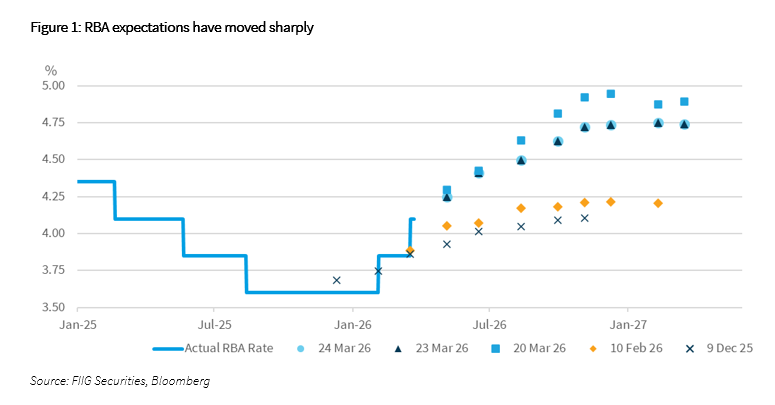
The market has been moving sharply since the start of the war in the middle east. But even that is very hard to calibrate. The RBA would respond to inflation but their reaction function to inflation caused by strength in the economy is different to their reaction function to inflation caused by a supply shock.
Every situation is different, but we expect that if faced with a true stagflation event because of the movements in oil prices, the RBA would strike a balance between fighting inflation and decimating the economy. There is no level of the Australian cash rate which causes oil to be transportable through the Strait of Hormuz. If the oil price was soaring (further) and the Australian economy was weakening because of it (lower growth, higher unemployment) then we expect the RBA would take the cash rate to moderately restrictive but no further, even if the inflation rate was too high. During the early part of this week the market flirted with the idea that the RBA might take the cash rate as high as 5% (see chart). However, that didn’t seem plausible because that would be so detrimental to the economy it would likely trigger a severe recession.
The market calmed a little later in the week and pricing returned to a more modest number of future rate rises.
That doesn’t mean recession risk is fully avoided, but it does lower the chances. However, the painful truth about war is that nobody wins – not even noncombatant countries like Australia. The overall global productive capacity of the economy has been materially reduced because of the loss of the Strait of Hormuz and of the energy assets around it. The global economy is going to produce fewer goods, with higher prices, than before. That will be true in Australia as well.