We identify the key themes to come out of the 1H26 reporting season for Australian major banks. Here we discuss these trends and the implications for the banks.
Background
Now that the 1H26 reporting season has come to a close, we thought it was timely to check in on the performance of the Australian major banks (CBA, ANZ, NAB, Westpac). They account for a significant portion of Australian debt market issuance as well as providing insight into the strength of Australian businesses and consumers. Most of the big four banks were reporting results for Q1 26 but CBA is on a different reporting cycle and so its results were for HY26. A rather rapid changing of economic conditions since this reporting period will make the results somewhat outdated. We have had a large geopolitical conflict along with a revision of the Reserve Bank of Australia (RBA) rate path, both of which will likely impact the full year earnings of the banks. Of smaller implication but still a consideration for future results is the RBA’s recent decision to ban credit card merchant fees.
Key trends and performance
There were no huge shocks in this reporting season as the banks continue to be in a strong position and analysis will focus on the finer details that separate these companies. Arrears remain contained, the banks are placing an emphasis on cost management and each bank is well above capital requirements. Mortgage competition continues to be intense between the four banks along with Macquarie’s rapid growth leading to their emergence as a legitimate threat to the majors.
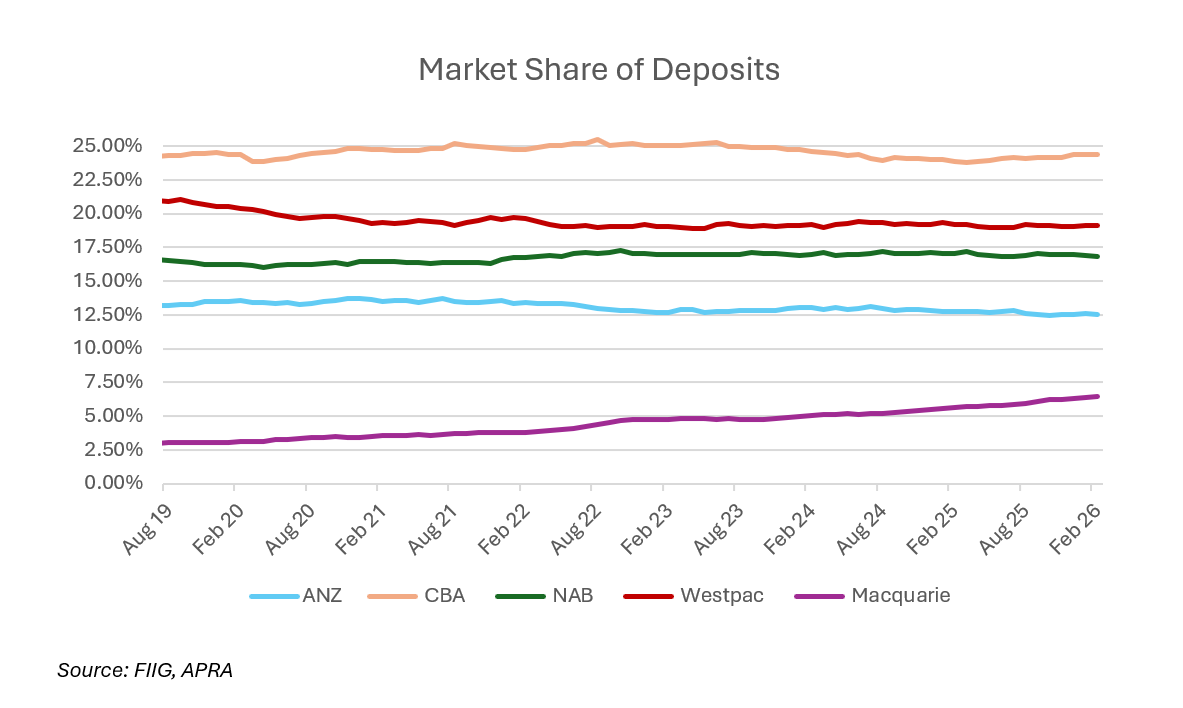
In the February APRA Authorised Deposit-Taking Institutions (ADI) statistics Macquarie had a 3-month annualised growth of 23.3% for housing lending along with a number of mutuals growing above system, while the majors mostly grew in line with the system. Macquarie was also a clear outlier on the deposit side with their market share doubling since 2019 whilst the majors grew at system. There are reports across the industry of some of the smaller players engaging in riskier behaviour in order to win business in a competitive environment. Whilst this is mostly in personal loans, we do not think that the majors would follow suit, but it does increase the contagion risk across the entire sector.
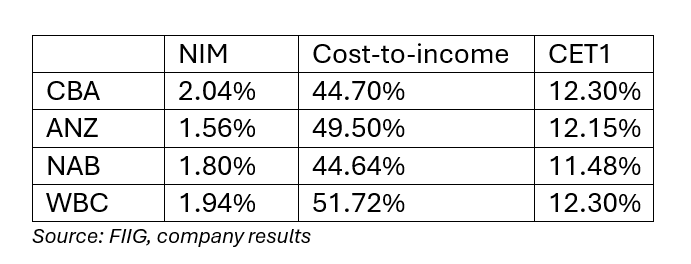
A breakdown of key statistics among the major banks can be seen below.
CBA
CBA continues to be the leader in the pack with the highest net interest margin (NIM) at 2.04%. Cash profit was up 6% which was strong although it was a smaller percentage increase than some of the other majors. This would be influenced by scale, but they also saw operating expenses increase. Inflation felt through wage inflation and IT vendor increases along with investment in technology were the main contributors to the 5.5% increase in operating expenses for the half. One positive was deposit growth that increased above the system (1.1x). Household deposits grew at 9% which was above the 10yr Compound Annual Growth Rate (CAGR) of 8.4%. Home lending in Australia was in line with system, home lending was higher in New Zealand which was 1.3x and Australian business lending was 1.3x. Group margin was slightly lower due to tighter home loan pricing and increase in liquid assets and repos. Capital is in a solid position with Common Equity Tier 1 (CET1) at 12.30%, Loan Coverage Ratio (LCR) at 132% and Net Stable Funding Ratio (NSFR) at 117%.
ANZ
ANZ reported strong profit growth of 17% (excluded significant items) as the bank makes good progress in cost cutting measures and the integration of Suncorp bank. Growth drivers were a favourable funding mix and higher earnings on replicating portfolios. NIM ticked up slightly to 1.56% and cost to income ratio decreased to 49.5%. Balance sheet metrics also improved with CET1 ratio up 12bps to 12.15% and customer deposits up 5%. Liquidity was relatively stable with the LCR of 133% and NSFR of 116%. Portfolio losses remain low and Australian housing loans 90+ days past due was 81 basis points (bps), down 5bps from September.
NAB
NAB reported a strong result with underlying profit up 12% on 2H 25 due to higher loan volumes in both business and housing lending. Business lending grew slowly at 2% while home lending grew 1.1x system. Deposit balances grew 3% and they completed the migration of Citi Consumer business customers onto Nab systems. Credit quality of their loan book improved over the period, the ratio of CP (collective provision) to credit RWA (risk weighted assets) decreased 2bp. The ratio of non-performing exposures to GLAs (Gross loans and acceptances) decreased 8bp from September. The ratio of impaired assets to GLAs was stable. The CET1 ratio decreased slightly to 11.48% (down from 11.70%) due to the final dividend payment and AUD6bn growth in RWA, most of which is attributed to volume growth. Both the liquidity coverage ratio and net stable funding ratio ticked up slightly, each 1% higher than the previous quarter.
Westpac
Westpac rounded out the earnings update with a 5% increase in profits to AUD1.9bn. They have increased institutional lending and have a higher proprietary lending mix in business. Net interest income increased 2% which more than offset the 4% decline in non-interest income. The increase was due to balance sheet growth and improved performance from Treasury. NIM however decreased slightly to 1.94% due to competition and lower interest rate environment. Deposits increased by AUD12bn and lending increased by AUD22bn. The largest percentage increase in lending was in the institutional division (+7%). They sold their RAMS mortgage portfolio in November to increase capacity to lend to higher returning portfolios. CET1 sits at 12.30% as all the banks sit comfortably above capital requirements. Impairment charges were low at just 6bp of average gross loans.
Conclusion
Overall, this was a fairly strong set of results for the banks. We are continuing to see low levels of arrears and non-performing loans. Some of this is due to economic strength but there is also a structural component as the majors have become more selective with the loans that they are writing and staying away from riskier areas. The main focus then shifts to deposit and lending growth, both areas of increasing competition. The chart below shows that CBA remains on top but the majors have failed to really increase market share over the past few years while Macquarie is increasing rapidly, albeit from a lower base. Deposits are the cheapest form of funding for the banks, so a decrease in deposits could place pressure on their NIMs along with requiring more capital markets funding.