The FIIG Research Team recently released its Quarterly Macro Outlook, which provides insight into what to watch in markets over the period and how best to position fixed income portfolios. Here we provide a condensed version of the article, highlighting the key themes.
Background
The situation in the Middle East, will continue to have an impact on markets, even should an agreement between Iran and the US be reached very soon.
This is particularly true when the market under consideration is the oil market, and there is more than just financial risk. The oil price is, in many ways, the price of energy more broadly and energy is the bedrock of the economy.
In this edition of the Quarterly Macro Outlook we are choosing to focus on some of the background questions and longer-term implications of the war. Specifically, what happens to the economy if there is an inflationary surge in coming months? At least something of an increase in inflation is already locked in because the price of oil has been high over March and April. Given the level of physical destruction in Middle East infrastructure, and the delays in oil shipments, the oil price will not fall back to pre-war levels just because a peace is reached. The increase in inflation is likely to be material, even if the war finishes tomorrow (or, indeed, has finished between me writing this and you reading it).
We start this outlook with a discussion of where the economy was before the war started. We continue with some thought about how the increase in oil prices will impact the economy given the very low spare capacity available before the supply shock hit.
And we end the piece with our thoughts for investing in bonds which provide direct inflation protection and also indirect protection via their exposure to floating interest rates.
Section 1: An economy with some steam before the Middle East war and a Central Bank with some questions after it
The Middle East war has been destabilising for economies and financial markets around the world. Australia’s economy has been no exception and was already in a slightly precarious position before the war began.
The Reserve Bank of Australia (RBA) had already raised rates in February because inflation was uncomfortably high in an economy with rising consumer demand and very little spare capacity.
The RBA immediately raised rates again in March. We are convinced that, in the absence of the war, there would not have been a rate rise in March, but the RBA would instead have waited to see some more data. Even with the sharp and obvious increase in inflation caused by the war, the RBA vote was only 5-4 in favour of the rise. It’s not too hard to imagine one board-member changing their mind in the absence of the war.
An important dynamic here is that the RBA is, in essence, trying to fine-tune the economy at present. Fine-tuning the economy is much harder than simply trying to stimulate (or contract) it.
The RBA lowered the cash rate three times in 2025 and there was a material upswing in the consumer side of the economy because of that. At the same time there was a decent increase in the amount of Private Investment too. This caused the rate rise that happened in February. There was also some speculation about the role of Government spending in the inflation surge. As we wrote in January, the Government wasn’t triggering the inflation directly, but they had used up much of the spare capacity across prior years, which meant there was no spare capacity left when the household sector tried to grow.
So that’s where we were when the war began – with an economy that had just started to trigger its own inflation, but with decent hopes that the inflation would cool off. Part of the inflation was intrinsically temporary, being linked to expiring subsidies, but there was also hope that the RBA rate move in February might be enough. The war caused a material rise in inflation and in inflation expectations. For now, we are waiting to find out how much longer the war will last, but also how much inflation has already been triggered.
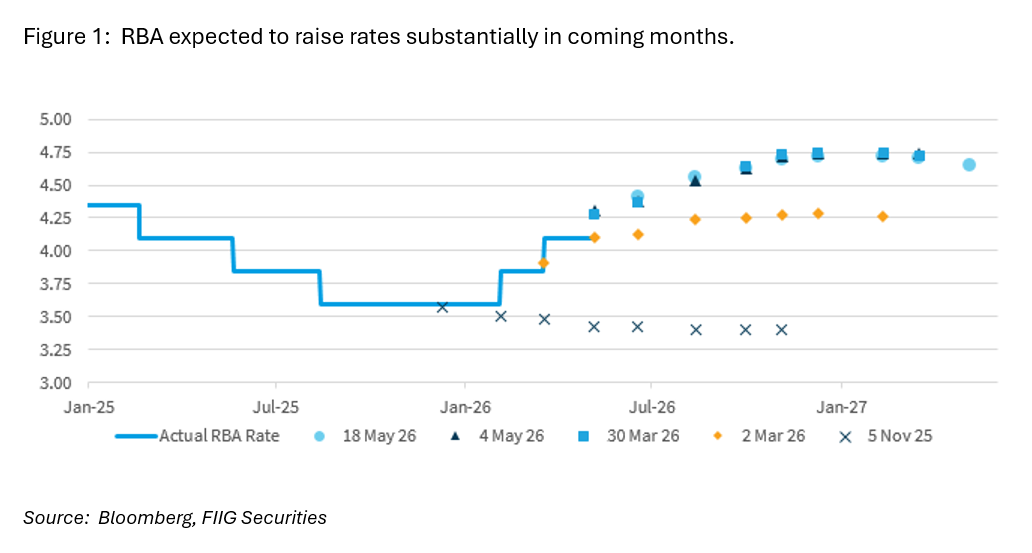
The markets are expecting another one and a half cumulative rate rises from here by the end of the year, which would take the cash rate higher than it was in the 2024 peak.
Section 2: What supply-driven inflation will look like in the Australian economy
The rise in inflation triggered directly by increases in the petrol price is painfully obvious. There are two important areas of uncertainty, though. The first is how long the petrol prices are going to remain elevated. The second is how much and how quickly the rise in petrol prices is going to trigger second round effects in other items, predominantly other goods.
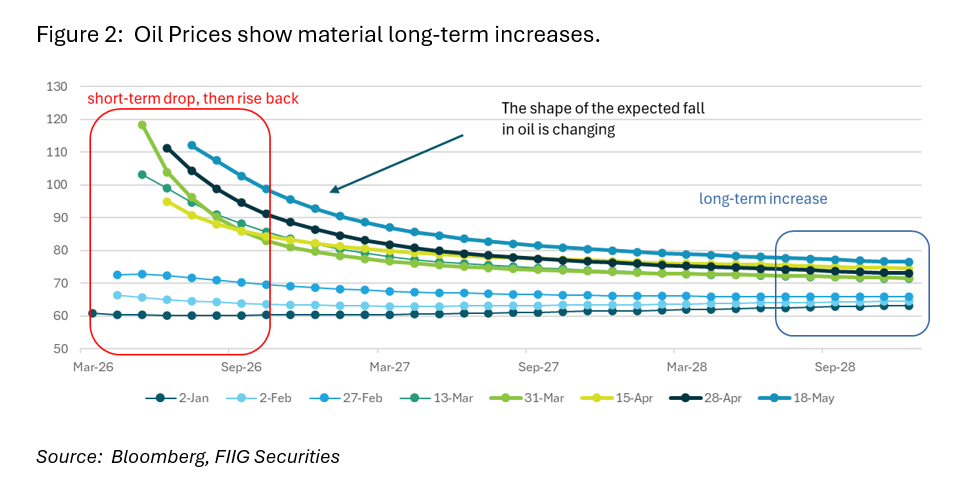
A key point to make is that the price of petrol is very unlikely return to previous levels for a very long time. It’s only one piece of information, but there are active petrol prices for Brent Oil out to December 2028 which show elevated oil prices for years.
Figure 2 shows the price of oil in the market across time. On each historical day marked, the prices represent what price needed to be paid to receive oil delivered on the future dates suggested. The war caused a massive increase in short-term prices. In January and early February, oil prices had been between about USD60 and USD70 dollars. Once the war started the price of petrol to be delivered in early 2026 rose to over USD100. It has since started to drop back down. The charts suggests that the longer the war has dragged on the higher the long-term price of petrol has become.
This sort of economic disturbance is called a supply shock because it changes the amount of aggregate supply in the economy.
Comparing where we are now, to where we were before the war, the total amount of oil available to be consumed is simply lower. However, the value of the money in the economy is the same. The same amount of money chasing fewer total products is what leads to inflation.
Oil is a particularly important commodity since it provides transport to almost all goods we buy. The effective cost of goods delivered and purchased by consumers rises since all goods are exposed to the cost of transport.
We have focused on oil until now, but it’s worth pointing out that this supply shock quickly becomes about more than oil and transport. Fertilisers are also being significantly affected by the delays but there are many categories. According to the World Economic Forum, the most important items affected by the shutdown of the Strait are, after oil and in order of importance: Fertilisers, Sulphur (used in batteries), Methanol (used in plastics), Graphite (used in batteries), Aluminium, Helium (used in healthcare, notably MRIs), Glycol (an element of polyester), Iron Ore and Hydrogen Infrastructure.
The same arguments about a reduction in total global supply apply to each of these categories too. We can now start to understand the broader impacts of the war and why the RBA was so quick to respond. This is not a transitory impact on a limited number of items. There is a transitory peak, but the underlying inflationary effect is quite long-lasting.
Yields are elevated across the curve, but an inflation outbreak that could last longer than markets currently suggest also means some caution is still warranted before taking duration. There are many other options, however, including floating rate notes and inflation linked bonds, which is the subject of our final section
Section 3: Bond strategy for a post-war reality, inflation protection and more
We’ve discussed above why we strongly believe that short and medium-term inflation linked bonds are an excellent defensive asset at this time.
The most obvious candidate is the Sydney Airport Nov-30. We’ve mentioned this bond before, but as an inflation linked bond with only a 4.5-year maturity it is very well suited to investors who are worried there might be a burst of inflation in coming years. The Sydney Airport line is one of the few inflation-linked bonds issued by someone other than a government, which means clients receive a credit spread too. At present, this bond is offering a yield of CPI + 3.42% or so.
For those who want a little more safety, the Government inflation linked bonds maturing in September 2030, November 2032 and August 2035 are also strong contenders. The Nov-32 is currently offering a CPI +1.94%, while the Aug-35 is more like CPI + 2.29%
However, your portfolio shouldn’t be only inflation linked bonds.
Despite the backdrop, we think now is a good time to take credit risk, particularly in the longer-term riskier names, where there is enough likely tightening of credit spreads to temper any further sell-off in yields. We would need fairly high yields to tempt us into fixed-rate space, but there are a handful of investment grade options paying in the range of 7% at present. Those sorts of numbers are high enough that they are likely to ride out any further sell-off quite well.
We would not be looking to take the higher-grade credit in fixed space at present. We need to keep a balance of fixed, floating and inflation linked in the portfolio. Right now, we would only be taking fixed rate when tempted by high spreads, but would look to take new exposures to investment grade credits in the floating space.
A period of higher inflation seems likely but by deliberately selecting inflation-linked and floating rate offerings a well-diversified bond portfolio will continue to allow your bonds to perform their investment role of protecting capital and providing income.