FIIG clients have access to a broad range of bank bonds, including not only those issued by Australia's major banks but also securities issued by leading European banking institutions. This broader range of issuers within the same sector provides many benefits for a fixed income portfolio, of which we discuss in this piece.
Background
European bank bonds provide Australian fixed income investors with access to a broader opportunity set than is available purely through domestic bank issuance. While the Australian banking market is dominated by a small number of highly rated institutions with similar business models, Europe offers exposure to large global universal banks, domestic retail lenders, cooperative institutions and cross-border banking groups. The sector has emerged from more than a decade of post-financial-crisis reforms with stronger capital positions, improved liquidity and more robust regulatory oversight. However, the investment case is increasingly influenced by macroeconomic conditions, sovereign dynamics and regulatory developments rather than balance-sheet repair alone.
Why European Banks Matter for Australian Investors
For Australian investors, diversification within the local banking sector is often limited. Moving away from the major banks frequently means taking exposure to smaller regional lenders or specialist finance companies that remain linked to the same domestic economic drivers. European banks broaden that opportunity set by providing exposure to different growth cycles, regulatory environments and interest-rate settings. They can therefore complement Australian bank holdings rather than replace them.
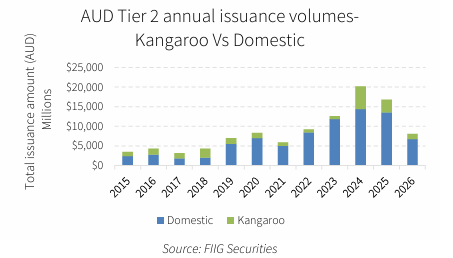
European issuers have also become more visible in the Australian dollar market through Kangaroo bond issuance. The growth in issuance has increased accessibility for Australian investors and has created additional opportunities to compare relative value across jurisdictions. In periods where Australian bank issuance is limited, European banks can provide a useful source of supply and portfolio diversification.
European Banks versus Australian Banks
The most important distinction is business model. Australian banks remain heavily focused on residential mortgages, consumer banking and business lending. Many large European institutions operate universal banking models that include investment banking, capital markets activities, wealth management, insurance and international corporate banking. This broader revenue mix creates diversification benefits but also introduces additional earnings volatility and complexity.
Geography is equally important. Australian banks are closely tied to a single economic system. European banks frequently operate across several countries and are influenced by different economic cycles, sovereign risks and policy environments. As a result, investors need to consider factors such as regional growth, fiscal policy and political developments when assessing credit quality.
Capital Structure and AT1 Securities
European banks generally have more layered capital structures than Australian banks. European issuers offer investors access to senior preferred debt, senior non-preferred debt, Tier 2 capital and Additional Tier 1 (AT1) securities. While this provides greater choice, it also requires a stronger understanding of where a bond sits within the loss-absorption hierarchy.
A key distinction for Australian investors is that AT1 securities remain an active component of European bank capital structures, whereas Australian bank hybrids are gradually being phased out following APRA's decision to remove AT1 as a form of regulatory capital for the major banks. As existing Australian bank hybrids are redeemed over time, investors seeking exposure to this part of the capital structure will increasingly encounter it through international issuers rather than domestic banks.
AT1 securities are particularly important because they remain an active part of European bank funding structures. These instruments can have coupons cancelled, may not be called at the first opportunity and can be written down or converted into equity during periods of severe stress. The Credit Suisse resolution in 2023 demonstrated that AT1 securities behave much more like equity than traditional bonds when regulatory intervention occurs. The additional yield available on AT1 securities should therefore be assessed in the context of their higher exposure to coupon cancellation, extension risk and principal loss.
Key Themes Driving the Sector
European banks have benefited significantly from the higher interest rate environment of recent years, with rising rates supporting net interest income and profitability across the sector. While policy rates remain elevated and could increase further, the benefits from higher rates are becoming less straightforward as deposit competition rises, lending demand remains subdued and balance-sheet growth slows.
At the same time, banks continue to adopt conservative lending standards. Corporate borrowers remain cautious and consumer demand for credit has softened. From a credit perspective, this is broadly positive because slower loan growth reduces the risk of future asset-quality deterioration. The trade-off is that revenue growth becomes more difficult to achieve.
Regulation is becoming an increasingly important driver of relative credit performance. European banks are substantially better capitalised than they were before the Global Financial Crisis, but regulatory requirements continue to evolve. The clearest example is Switzerland, where authorities continue to review capital rules for UBS following its acquisition of Credit Suisse. Proposed reforms would require UBS to hold additional loss-absorbing capital against its international operations, reinforcing balance-sheet resilience but potentially reducing capital efficiency and shareholder returns. For bondholders, these developments are generally supportive because they place more equity and subordinated capital beneath the debt stack.
Implications for Bond Investors
Meaningful analysis starts by grouping comparable institutions together. Diversified universal banks should be compared with other universal banks rather than domestic retail lenders. Likewise, spread comparisons are only useful when securities occupy a similar position within the capital structure. This is particularly important when comparing European bank bonds with Australian bank issuance, where differences in business models, regulatory frameworks and capital structures can make direct spread comparisons misleading.
Investors should also look beyond headline capital ratios. Capital requirements differ by jurisdiction and institution, meaning a higher reported CET1 ratio does not automatically indicate a stronger credit profile. Greater attention should be paid to management buffers, earnings resilience, funding diversity and the quantity of subordinated capital below a bond.
The most attractive opportunities are often those where spreads compensate investors for a clearly identifiable risk, such as sovereign exposure or regulatory uncertainty, rather than for unexplained balance-sheet concerns.
Conclusion
The European banking sector is considerably stronger than it was a decade ago, supported by improved capital, liquidity and regulatory frameworks. Nevertheless, it remains a more complex investment universe than Australia. Credit outcomes are increasingly shaped by macroeconomic conditions, sovereign developments and regulatory change, rather than solely by balance-sheet considerations. For Australian investors, European bank bonds can provide valuable diversification, attractive income opportunities and access to a broader range of issuers. Success, however, depends on disciplined issuer selection, a clear understanding of capital structures and careful assessment of regional risk drivers.