Background
Historically, Australian investors have been overweight (in an asset allocation sense) to cash, shares and property. However, with the development of the AUD-bond market into the third largest primary market in the world, Australian investors searching for low-risk alternatives for the defensive portion of their portfolio now have a vastly improved range of bond options to choose from.
Despite the fact that bonds are new to many Australian investors they are by no means a new asset class. In this piece we discuss larger allocation some of the world’s largest companies have to the fixed income class, as opposed to other investment options.
Allocation to bonds
While bonds might be lesser well-known to many Australians, it’s an asset class that has been around for many years and has a long history. Early bonds were frequently issued to fund wars or further a country’s imperial ambitions at sea. In 1694, the Bank of England was established with an initial goal of raising GBP1.2m to help England to build a navy to rival that of its perennial enemy and neighbour France.
Bond certificates were elaborate and artistic affairs (see here) with ‘coupons’ that could be clipped off the bottom and periodically redeemed for cash. In the current technology driven world the payment of coupons is a rather more streamlined process albeit perhaps lacking the artistic flair of days gone by. Personally, I think that this background is very important. It points to the fact that, whilst bonds are new to many Australian investors, they are not some new age and untested product, having been around for many hundreds of years.
A couple of years ago, Berkshire Hathaway was in the headlines for building a monumental store of cash, selling half of its huge stake in Apple. The last reported cash and low risk investments balance was US$359.2bn. Quite apart from the size, it was the change that drew attention, with US$149.9bn being added, and subsequently maintained at this higher level. Buffett’s retirement has put this huge cash pile into focus, and of course market commentators are demanding the company does something with it, instantly forgetting how this vast cash hoard was built in the first place.
Historically these giant companies have been sitting on huge piles of cash. A few years ago, technology giant Apple was hitting the headlines for its cash plie which was c.US$270bn at the time. Like everyone else I was blown away by the size of its cash holdings but unlike many others, who might have perhaps had more interesting matters to dwell on, I was also very curious as to how Apple managed and invested those funds. Was it simply kept in cash and term deposits or did they take a more sophisticated approach? It does not take a genius to work out that even an extra 0.1% or 0.2% return on US$270bn is a substantial amount of money i.e. US$270m – US$540m.
I was not at all surprised to see that Apple was actually very active in managing its funds and indeed very little was left in cash and term deposits. Given that a few years have passed I thought it was worth revisiting Apple’s approach along with that of a handful of its well-known peers. I do not think that it is overstating it to say that these are some of the largest, most sophisticated and most successful companies in the world.
They are leading the way in their industries and they also continue to lead the world in their cash management practices. The chart below reflects broadly how these companies invest their cash holdings. Currently these companies are each managing cash holdings of c.US$21bn – US$65bn.
To perhaps state the obvious, this is vastly more than the majority of the world’s professional investment managers have under management. However, mainstream investment managers will be managing assets across a range of different mandates from very low risk to high risk. When looking at these companies we are talking about corporate cash meaning that the mandate will always be low risk with the protection of capital paramount at all times.
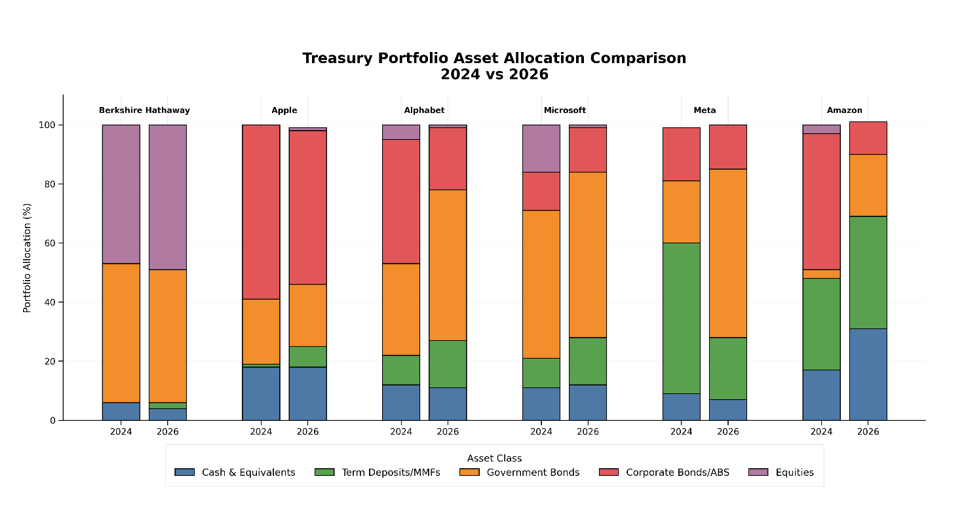
Berkshire is the largest by some distance, holding ~US$660bn in total of marketable securities vs Alphabet next in line with ‘just’ US$177bn, but it is obviously quite different with its huge equity holdings. It is still insightful that for the vast majority of its non-equity assets it chooses not cash but government bonds.
All of these companies hold about the same amount of cash as a percentage than the last time we looked, but interestingly, all hold a lot more government bonds than they previously did at the expense of corporate bonds, with the exception of Meta, which has clearly moved from money market funds to government bonds.
Amazon and Alphabet have also repositioned into government bonds. I suspect this is due to the liquidity required to fund their immense AI buildout may not be available in such huge size in the corporate market, and as such they are foregoing some yield to boost liquidity.
As stated above bonds have been around for many centuries. Even credit rating agency Standard & Poor’s Global, which offers oversight (of sorts) to the bond market, has been around since 1860. Such ratings consistently point to investment grade bonds, those rated BBB- or better, being the safest part of the market. While we do not have the detailed breakdown we can be very confident that the vast majority of the exposures detailed above are in highly rated investment grade bonds.
Conclusion
These companies have very large cash balances; however they are all still doing their utmost to extract the best possible return whilst keeping a keen eye on risk. In Australia, while allocation to bonds is growing it remains extremely low by all international comparisons. We think that if the largest, most sophisticated and successful international companies in the world are heavily allocating towards bonds then any groups and/or individuals sitting on high levels of cash should also be seriously considering the same.