Following the recent reporting season, FIIG’s Research team provides an overview of the key themes and sectors to emerge from FY26. Here they provide an update of the sectors and companies covered during the FY26 reporting season.
Introduction
The August reporting season was overall a positive reporting season, although some companies have flagged potential headwinds going forward. The FY26 results were strong but geopolitical tensions, high inflation and RBA rate hikes have resulted in lower consumer confidence and expectations of a challenging period going forward. Some companies have revised down their FY27 earnings forecasts on the back of some of these factors.
Whilst there are many takeaways from this reporting season, we have chosen a few of the major themes to discuss. These are the data centre boom, a change to the mortgage landscape and the continued recovery of Australian REITs.
Data Centres
A key theme from this year’s reporting season is the rapid expansion of data centres and growing investment in the sector. Not only was this topic mentioned in earnings calls of companies operating in that sector, such as NextDC and Goodman Group, but also in the earnings calls of many energy companies along with other REITs. Whilst it is well known that we are in the middle of a large data centre rollout, the size and pace of this is still rather astonishing.
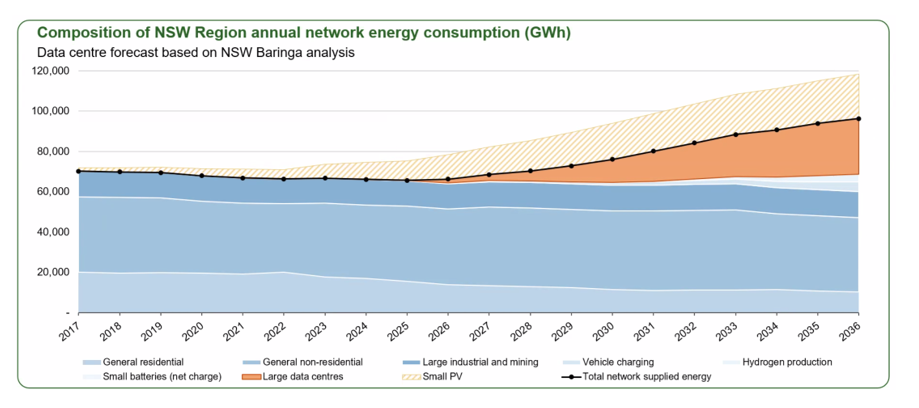
The numbers published by data centre operator NextDC show the pace at which demand has grown. In FY26, their contracted utilisation tripled, and their forward order book is now more than 3.2x their billing utilisation. Capex in FY26 doubled from the previous year and is expected to step up again next year, showing the cost of funding this expansion. Many energy companies discussed data centres as being a significant area of growth for them, especially if the government forces operators to bring their own energy supply to the grid. System demand in NSW for example had been flat/declining over recent years due to the take-up of solar and this is now expected to increase significantly by 2036.
Figure 1: Forecast NSW annual network consumption
Source: Transgrid Company Report
A Change in the Mortgage Landscape
One of the more consistent messages from the banks this reporting season was that mortgage demand is beginning to moderate, particularly in new loan applications. Westpac, NAB, Bendigo and ANZ all reported notable declines in home loan applications, with management teams repeatedly pointing to affordability pressures, softer consumer confidence and uncertainty following the Federal Budget. Importantly, the banks were careful to distinguish between current lending growth, which remains broadly positive, and future lending pipelines, which are showing signs of moderation. One notable exception was Liberty Financial, which reported little change in application volumes and continues to see strong demand in specialist lending segments. This suggests the slowdown is possibly more concentrated in the traditional prime mortgage market rather than across all borrower cohorts. Many lenders expect mortgage competition to heat up in FY27 as loan growth slows. This will likely place pressure on the net interest margin (NIM).
Despite generally stable credit metrics, management commentary across the sector has become noticeably more cautious. Arrears remain manageable, non-performing loan ratios remain low, and loss rates continue to sit below historical averages. However, ANZ increased collective provisions in response to heightened geopolitical uncertainty, NAB highlighted rising watch loans and Westpac strengthened overlays and downside scenario assumptions. The common message was that banks are becoming less confident in the economic outlook and are building additional buffers ahead of any potential slowdown. That is, management teams appear to be positioning for increased uncertainty before it becomes visible in headline asset quality measures.
REITs/ Property
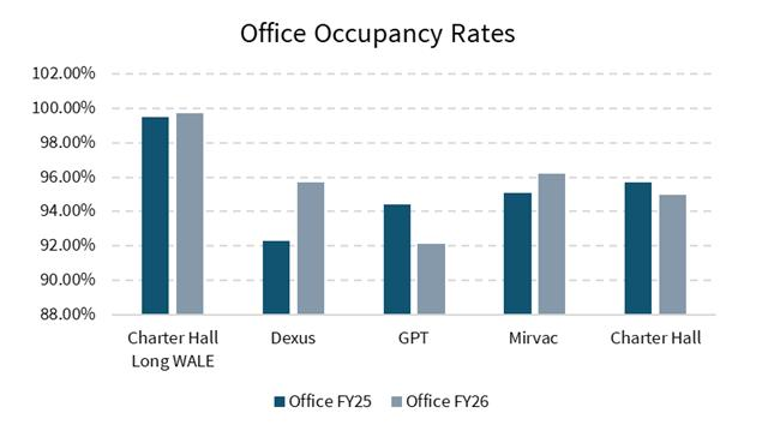
The recovery in the Australian REIT sector gained momentum during FY26. What set this update apart from earlier results is the improvement in the Office segment, which had been hit the hardest during the COVID-19 era and had taken the longest to recover. This was the first full year that the REITs reported positive valuations across their Office portfolios, and leasing spreads had improved also. With a lack of new supply in the space and demand for premium Office space (of which most REITs had repositioned portfolios towards), this helped with tenant demand and also occupancy rates.
Figure 2: Australian REIT occupancy rates for Office
Source: Company presentation, FIIG Securities
Following the RBA hiking the cash rate three times over 2H26 and changes to the Federal Budget that impacted consumer confidence, some property groups reported softer residential sales enquiries over the period. Stockland and Mirvac both reported a softer Q4 for enquiry volumes, although noting the QLD and WA markets were more resilient compared to NSW and VIC. Companies were not overly concerned about these changes yet, but they did flag that they may move capital to different projects if demand continues to soften. One such area for some REITs is data centres, where there is strong demand.
Conclusion
Overall, the FY26 reporting season was strong, although some dark clouds on the horizon could see a mixed FY27 outlook. With the Iran war still ongoing, persistent inflationary pressures, Federal Budget changes, and rising global rates, some companies and sectors will be more vulnerable to market conditions, while others will be more resilient. Careful selection across sectors and issuers will help add diversification to portfolios, along with a solid mix across different types of bonds and tenors.