There are different types of fixed income instruments in the bond market, which includes hybrid securities. In this piece we deep-dive into what a hybrid is and its unique features.
Background
Hybrid securities (hybrids) are among the most misunderstood investments available to Australian investors. They tend to be grouped with bonds because they pay regular income, but they also share some characteristics with shares. As their name suggests, hybrids sit somewhere between debt and equity.
For investors seeking a higher level of income than can typically be obtained from senior bonds, hybrids can play a role within a diversified portfolio. However, that additional income is not free, and should be thought of as compensation for taking on additional risk. Understanding where hybrids fit in the capital structure is the first step towards understanding both their benefits and their risks.
Why are they called hybrids?
A traditional bond is straightforward. An investor lends money to an issuer, receives regular interest payments in the form of coupons, and expects to have their capital repaid at maturity.
Ordinary shares are different. Shareholders own part of a company, benefit from profits through dividends and capital growth, but also bear losses first if a company experiences financial distress. Dividends are also discretionary and may not always be paid. Hybrids combine features of both.
Like bonds, hybrids generally pay a regular income stream and are often issued with future call, conversion or reset dates. However, like shares, they rank below senior creditors and can absorb losses under certain circumstances.
Unlike traditional bonds, hybrids do not always have a fixed maturity date. Some are perpetual securities, meaning they can remain outstanding indefinitely unless redeemed, converted or otherwise repaid by the issuer. As a result, hybrid investors often rely on future call or conversion dates rather than a contractual maturity date.
This combination of debt and equity characteristics is why they are referred to as "hybrids". While hybrids are often grouped alongside fixed income investments (because they pay regular income), investors should recognise that their risk profile typically sits between traditional bonds and ordinary shares.
Where do hybrids sit in the capital structure?
One of the most important concepts in fixed income investing is the capital structure.
The capital structure determines the order in which investors are repaid if an issuer enters liquidation or administration. Investors higher in the structure generally have lower risk but receive lower returns. Investors lower in the structure take on more risk and therefore demand higher returns.
A simplified bank capital structure, for instance, looks something like this:
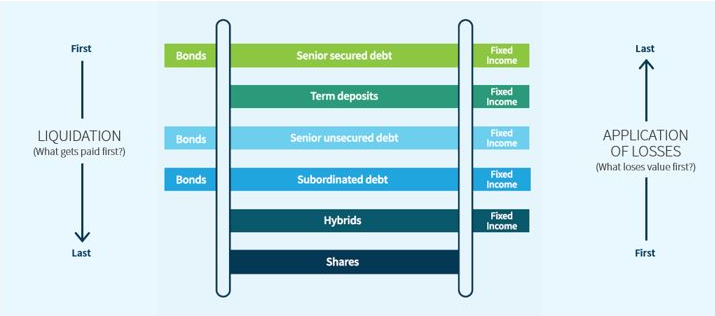
The lower an investor moves down this hierarchy, the greater the risk that losses may be experienced in a severe stress scenario. Hybrid investors rank ahead of shareholders but behind all forms of senior and subordinated debt.
This lower ranking is one of the key reasons hybrids generally offer higher running yields than senior bonds from the same issuer: investors want to be compensated for taking the risk that comes with being further down the capital structure.
Why do companies issue hybrids?
Hybrid securities can be issued by banks, insurers and corporates as a way of raising capital that sits between traditional debt and ordinary equity.
For issuers, hybrids can provide a flexible source of funding and, in some cases, may qualify as regulatory capital. Because hybrids rank lower in the capital structure and are designed to absorb losses ahead of senior creditors, investors typically require a higher return than they would for senior bonds.
Following APRA's decision to phase out AT1 securities as eligible bank regulatory capital, both listed and over-the-counter (OTC) AT1 issuance by Australian banks is expected to decline over time. As a result, the Australian hybrid market is gradually transitioning away from the bank-dominated structure investors became familiar with over the past decade. As existing AT1 securities are redeemed or otherwise roll off, other issuers and structures may account for a larger share of future hybrid issuance.
Despite these changes, the fundamental characteristics of hybrids remain unchanged. Whether issued by banks, insurers or corporates, hybrid securities continue to sit between debt and equity in the capital structure, offering investors higher potential income in exchange for accepting additional risks such as subordination, extension risk and, in some cases, loss absorption mechanisms.
How do hybrid income payments work?
Many hybrid securities pay floating-rate distributions based on a benchmark interest rate, typically Bank Bill Swap Rate (BBSW), plus a fixed margin. For example, a hybrid might pay a distribution equal to the 3-month BBSW plus a margin of 3.00%.
Unlike most bonds however, hybrid distributions may be subject to additional conditions. Depending on the security structure, payments may be deferred or cancelled in certain circumstances. In some cases, any unpaid distributions may not accrue, and investors may never recover that lost income. Investors should always review the terms of a specific issue rather than assuming it behaves like a conventional bond.
What are the key risks?
While hybrids are usually issued by high-quality institutions, they carry risks that differ from traditional bonds.
Subordination risk
The most obvious risk is their position in the capital structure. If an issuer experiences severe financial stress, losses are absorbed first by shareholders and then by hybrid investors before affecting senior bondholders.
Conversion risk
Many hybrids contain mechanisms that can convert the security into ordinary shares if specific trigger events occur. These triggers are designed to strengthen a bank's capital position during times of financial stress. Because conversion is typically associated with periods of financial stress, investors may receive shares worth materially less than the original face value of their investment. Depending on the structure, and in some extreme circumstances, investors may also face partial or total write-off of their investment.
Extension risk
Hybrids often have call dates rather than fixed maturity dates. Investors may expect a security to be redeemed on the first call date, but this is not guaranteed. If the issuer chooses not to redeem the security, investors may be exposed to the investment for longer than anticipated.
Distribution risk
Unlike traditional bond coupons, hybrid distributions may be deferred or cancelled in certain circumstances. Depending on the structure, missed distributions may not accumulate and investors may never recover that lost income, even if the issuer later returns to financial health.
This additional uncertainty is one of the reasons hybrids typically offer higher yields than senior bonds issued by the same institution. In contrast to most bonds, the failure to make a distribution on a hybrid does not necessarily constitute an event of default.
Market price volatility
Although hybrids are generally less volatile than shares, their prices can fluctuate more than senior bonds, particularly during periods of market stress.
Are hybrids safer than shares?
The simple answer is yes.
In the event of a liquidation, hybrid investors rank ahead of ordinary shareholders and therefore have a higher claim on company assets. Shareholders absorb losses first and are only entitled to any remaining value after all creditors and hybrid holders have been satisfied.
That certainly does not mean hybrids are risk-free. Instead, they sit between bonds and shares on the risk spectrum, offering investors a balance between the higher income potential of equity-like instruments and the greater capital protection typically associated with bonds.
Where do hybrids fit in a portfolio?
For many income-focused investors, hybrids can provide a middle ground between senior bonds and shares.
Investors willing to accept a modest increase in risk may be rewarded with higher income than is available from senior debt issued by the same institution. This can be particularly attractive when investing in strong investment-grade issuers where the probability of severe financial distress is considered low.
Hybrids should generally be viewed as a higher-risk allocation within a fixed income portfolio rather than a direct substitute for defensive senior bonds. For this reason, hybrids are often used as a complement to senior bonds rather than a replacement for them.
Conclusion
Hybrid securities occupy a unique position in Australian financial markets. They offer the potential for higher income than senior bonds, but that additional return comes from accepting a lower ranking in the capital structure and the possibility of absorbing losses in extreme circumstances.
For investors who understand these risks, hybrids can be a useful component of a diversified income portfolio. The key is recognising that while hybrids may share some characteristics with bonds, they are not bonds in the traditional sense. They sit between debt and equity, and investors should assess them and their risks accordingly.