FIIG recently published our Macro Outlook, discussing the current state of the bond markets and the larger investment trends. The themes identified this quarter were inflation against a backdrop of a rising unemployment rate and the credit risk in Government borrowers globally. There was also a section covering the mathematics of bond pricing in a higher yield environment. A Macro Outlook is published by FIIG in the first month of each quarter.
The world is not a happy place at present. Explaining what is happening in the economy and in the markets requires an understanding that the current story of markets is not one story, but multiple threads all vying for attention in a tapestry. The geopolitical risk is an important element, but only one part of the overall story. Inflation is in the picture too, both as background and as a response to the wars in the Middle East and in Ukraine. The weakening of the Australian economy is another thread that is clear when one looks at unemployment, though also one that is at odds with the AI boom that is so clearly taking place and so clearly sucking up much of the world’s capital. The RBA is raising rates but is risking doing damage to the economy and lifting the unemployment rate by doing so.
The geopolitical risks and the reality of two wars in major energy hubs (Ukraine and the Middle East) are manifesting as higher transport prices in Australia. These transport costs are then adding to an already high inflation rate triggered by domestic demand and creating a very uncomfortable situation (as consumer confidence attests to). The RBA is responding to inflation by raising rates, even though signs of cracks are starting to emerge in the economy. The RBA is becoming increasingly alarmed by the results of their business liaison, which are reportedly showing that inflation expectations are starting to change and businesses are preparing to pass through any rise in input costs. That’s a recipe for a major inflation breakout which is why the RBA has reacted so strongly.
Meanwhile, the Australian labour market continues to weaken and property price falls are becoming substantial. The Governments (Federal and State) have a big decision to make in the coming months as we approach mid-year budget updates. They’ll need to decide between spending money they don’t really have to string along the economy for a short while longer or letting the current cycle run its natural course. Letting the cycle run its course will result in an economic slowdown coming comparatively soon.
In our recently published Macro Outlook there were three main sections. The first section looked at the traditional economic measures the RBA targets: inflation and employment. While inflation is too high, the unemployment rate is starting to rise fairly consistently. At the very least, the rising unemployment rate ought to convince the RBA that the current settings of monetary policy are relatively restrictive, even if the inflation rate is proving sticky. That doesn’t mean the RBA won’t raise rates again, even after the November rate rise just delivered, but it does mean that the interest rate cycle can’t extend too much more before something really starts to give. Unfortunately, just because further RBA actions now might cause a material slowdown in the future doesn’t mean the RBA won’t be forced to deliver those rate rises.
The second section looked at the risks inherent in government bonds, globally, at present. While there is growing risk in this sector which is being captured by higher yields, Australian government bonds appear comparatively more resilient than those of many international peers. Australia’s situation is not perfect and yes, we could have a lower deficit and a lower total debt. However, compared to the problematic countries, we’re doing solidly and this should be acknowledged.
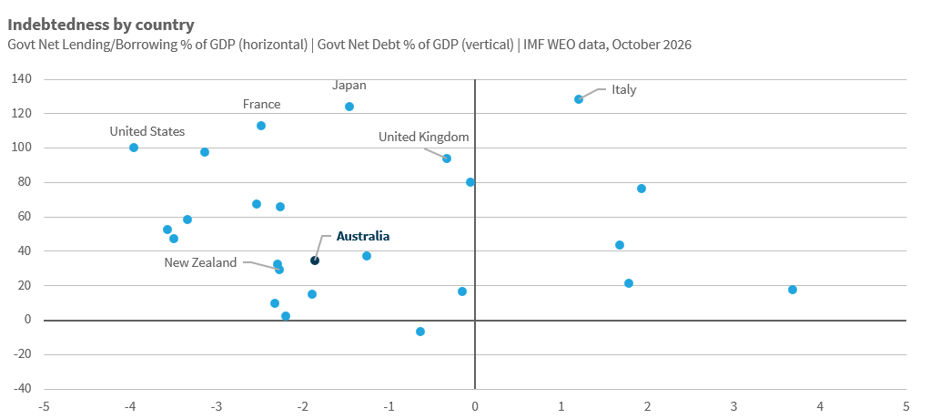
Source: FIIG, IMF WEO
The risks inherent in the situation are being seen in rising credit spreads, too. But these threads are not independent of the first set of concerns. As shown in France, the economic reality of life is causing demands on the Government, but the Government doesn’t have full freedom to act. Their hands are bound by the reality of borrowing money as a highly-indebted government. Many governments around the world may be forced to stand by and allow the slowdown to impact consumers because they don’t really have any other option.
Bond yields are not preparing for a slowdown just yet, however. They are responding to the global balance of capital. Between government borrowing (globally) and AI-related infrastructure spending, there is an imbalance at present. The demand for capital is very strong, while the supply of capital in many markets is smaller as Asian money gets repatriated home. This overall situation feels terrible for consumers who are essentially crushed between the irresistible force of AI investment spending and the immovable object of government borrowing.
There has been a strong sell-off in bond prices in recent months, which raises the yields and causes losses for existing fixed rate bonds. However, it also materially affects the prospects of new bonds in a positive way. Yes, the bonds have higher yields, which is a benefit, but it is easy to underestimate how much of a benefit that is. There are two important features of bonds - specifically that conventional bonds earn interest as compound interest and that bonds have a duration that is affected by their yield - which combined mean that higher yields benefit bonds in a non-linear way. The near-term prospects for a bond improve as the yield rises, but this improvement is much greater than a simple linear interpretation might have you believe. The third section of the Macro Outlook explains the beneficial impact of higher yields on bonds, specifically on the holding period breakeven for bond investments.
Our Macro outlook was published in late October (and so before the RBA decision on Tuesday), but the RBA’s decision to raise rates is very much in line with our expectations. The RBA is likely going to try to solve the inflation problem first, even if that means causing a faster rise in the unemployment rate. There remains a solid risk that the RBA hasn’t finished the rate rise cycle yet. The bigger macroeconomic risk is that by seeking to control inflation in the short-term, the RBA is sowing the seeds of a material slow-down in the medium-term.