The overall situation of the economy in late July 2026 is one of economic resilience paired with gathering risks. As we’ve mentioned before, the overall economy is doing much better than the consumers in it, at present. The Government sector and the investment sector (particularly data centres) are both absorbing a good deal of the productive capacity of the economy. There’s little left for consumers and this combination of excess demand and supply constraints is pushing the cost of living higher. The policy makers are faced with difficult choices as they try to protect the strong level of employment the economy currently enjoys while also preventing inflation from becoming too much of a recurrent theme.
The RBA has raised rates three times in this cycle, taking the cash rate back to the previous high of 4.35%. At present, the RBA is sitting back waiting to see how the data develops before deciding the next steps. They will have been heartened by the most recent data, we expect, which has shown resilient labour markets and inflation not as bad as feared. We’re not out of the woods, though.
Inflation has been too high for several quarters and it remains too high. The most recent CPI print (released 29 July) showed trimmed mean annual inflation in the year to the June quarter was well above target at 3.6%, but this was also below the RBA’s forecasts (made in the May SoMP) that inflation would be 3.8%. The headline inflation rate for the month of June was -0.1%, following the -0.7% seen in May. The annual rate remains high at 3.8% but this rate reflects the rise in petrol prices around the start of the Iran War.
The RBA doesn’t want to raise rates unnecessarily, but also doesn’t want to let inflation get so high and stay there so long that inflation, and more importantly any inflation expectations, become entrenched.
The general economic commentariat splits into two camps at present: those who think that there will be another rate rise in 2026 and those who think the RBA is done and the next move will be a (possibly distant) rate cut sometime in 2027.
We can see merit in both positions though do see a further rate rise as probably slightly more likely than the current market expectation. The RBA is not giving a strong indication either way which is, I believe, largely because the RBA doesn’t know themselves. They’re not being unnecessarily coy; they’re facing up to the reality that 75bp of rate rises is a decent pushback against a burst of inflation, but not an overwhelming response. Depending on how the data develops over the course of the year, the RBA might need to raise rates again or might not. The RBA appears to be trying (somewhat unsuccessfully) to tell the market that at every chance they get, including the Anika Foundation speech given by the Governor on 28 July. However, markets don’t really like nuance, they tend to swing from one core understanding to the next (and back again). A couple of days ago markets were expecting a rate rise but the combination of the speech yesterday and the CPI data today has seen markets revise down their expectation to a cumulative 16bp of expected rises – or about a two-thirds chance of one more rate rise.
The biggest reason to think that the RBA might raise rates again is that the breadth of inflation is disconcertingly wide. Although the narrative is that the Iran War and petrol prices caused the rate rises – which is true up to a point – the recent burst of inflation started before the Iran war and is relatively broad. With an already broad inflation problem in the economy, the rise in the price of energy risks making the inflation problem entrenched and therefore very dangerous economically. Energy is embodied in almost every product and also in many services. Although the first-round effect of the Iran War is already embedded in petrol prices, the second-round effects are potentially very broad indeed. There are currently many more items than just petrol which are rising faster in price than the RBA’s target band. This chart shows the quarterly CPI data broken down by expenditure class. You can see that 64% of items are rising faster than the top of the RBA’s target band.
Figure 1: The breakdown of inflation using quarterly data
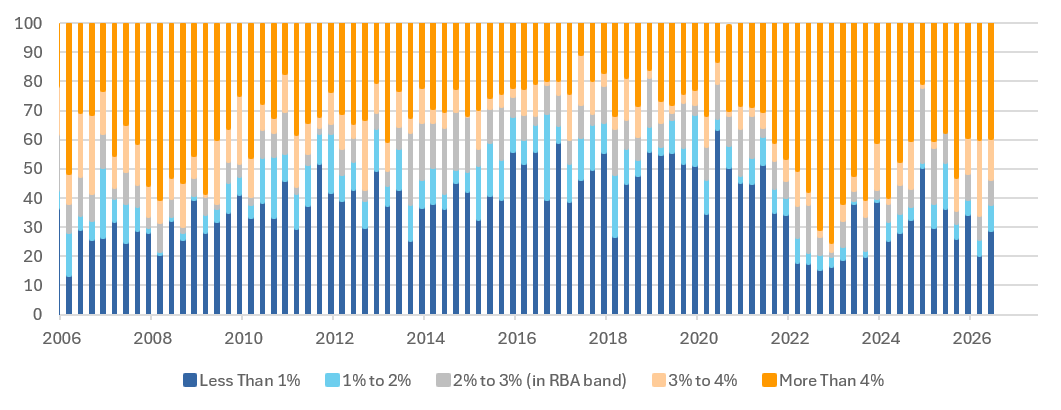
Source: RBA, FIIG Securities, ABS. Quarterly data annualised.
With the Iran War difficult to predict, we need to make sure we aren’t assuming that just because the Iran War seems to be coming to a close (Maybe? Hopefully?) that doesn’t mean our inflation problems are solved. Every extra inflation impulse from the war makes it more likely the RBA will need to raise rates further, but it’s not only about the Iran War, there was plenty of inflation in the system before the war began and it remains relatively widespread. The height of the peak is lower than the RBA feared, but the breadth of the problem remains considerable. Also, the current rate of inflation may not be as high as feared, but it remains well above the 2.5% target. This means the RBA will continue to press against inflation.
That’s the case for the RBA to remain vigilant and why they may need to raise rates again.
The biggest reasons pushing back the other way and encouraging the idea that there might not be any further movement upwards in rates are these:
- The RBA has already raised rates 75bp and this has not yet fully been felt in the economy. It takes between 6 and 18 months for the full effect of a rate increase to be felt, meaning that the February increase might be fully felt, the March, somewhat felt and the May increase not yet really felt much at all. We’ll only know that the previous rate hikes were insufficient if we wait to see their full effect.
- The property market is weakening. This is partially because of the rate rises, but also partially because the changes to Capital Gains Tax and negative gearing have dented confidence in property price appreciation. Falling property prices affect inflation directly (as fewer transactions means fewer houses refitted and refurbished) but also via the wealth effect. When people feel less wealthy (because property prices are falling) it tends to curtail spending. There’s also a possibility that younger potential first home owners might be encouraged to commence saving in order to buy a home now that the playing field has changed.
The 75bp of rises delivered so far would, in normal circumstances, be something like enough to temper inflation, but it is not overwhelmingly large. There may need to be further movements depending on how the data develops. The Australian data has been relatively strong even after the rate rises, suggesting the three rate rises already delivered might not be enough to fully cool inflation and something more will be needed.
The labour market continues to show surprising resilience. The unemployment rate is trending very slowly higher (from an incredibly low base). The most recent labour data also showed a significant increase in the participation rate. This might just be a one-month statistical anomaly in the data, or it might be a sign that the cost-of-living pressure is biting and increasing the supply side of the labour market (i.e. more people are looking for work because of inflation). The other way that this supply reaction in labour markets can be seen is in the rise in underemployment – which is people who are working fewer hours than they would like. However, that’s also a sign of more supply in the labour market, which helps to reduce inflation a bit too, so it can be read as a sign of resilience too.
Figure 2: Labour Market Participation rising – but underemployment is too
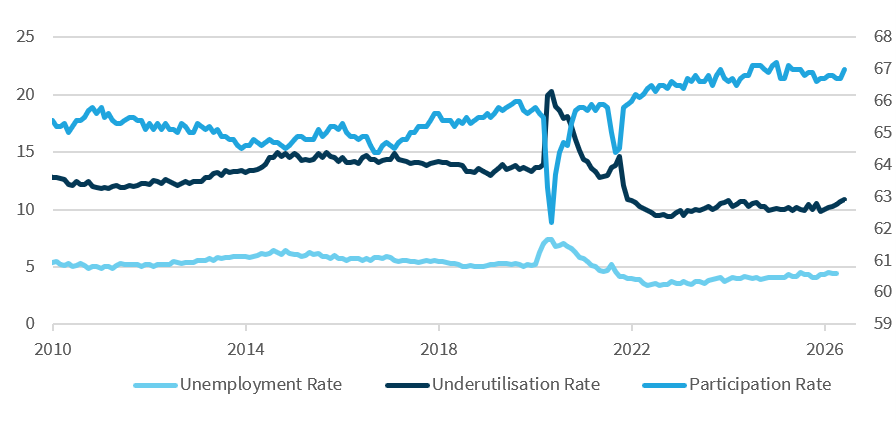
Source: FIIG Securities, ABS.
That “something more” to cool the economy in spite of the resilience doesn’t need to be a rate rise though. The extra tightening could also be fiscal policy or some external source. The budget was fiscal policy and the increase in taxation around property and capital gains has resulted in a fall in property prices. The property market normally falls a little when rates are near the top of their cycle, so it’s hard to know exactly how much of the recent weakness in property prices is to do with the overall level of rates and how much is to do with the tax changes. Either way, for the RBA the impact is clear. A material drop in house prices tends to cause a cooling in inflation and lowers the likelihood of further rate rises.
Our recently published macro outlook goes into these concepts in more detail, looking at the recent economic developments, before moving to the way bond markets are reacting. A very important argument we make is that bond markets are forward looking, so the best time to buy bonds is usually towards the end of the hiking cycle, not during the subsequent easing cycle. If investors wait until the case to cut rates is overwhelming, then the bond yields will likely already have dropped.
Our overall understanding of the economy is that there is a reasonable chance the RBA will be forced to raise rates again, because of the breadth of inflation in the market. However, we also think that the rate rise cycle is closer to the end than to the beginning. Historically, the best returns from bonds have tended to come by positioning for rate cutting cycles well before they have begun – and frequently before the prior rate rise cycle has completely finished. Bond yields remain well above the cash rate so even if there is another rate rise from here the overall yields available now are unlikely to increase much unless the economy evolves in an very unanticipated direction.