The 2026-27 Federal Budget had several key changes to the tax treatment on investments, leaving some investors impacted by the reform looking for alternative options. Bonds provide a regular income stream and can be a low-touch investment compared to other asset classes. Here we look at how bonds can provide an attractive alternative income solution.
Background
Some of the biggest changes to come out of the 2026-27 budget include changes to negative-gearing tax on investment properties and capital gains tax on investments. The negative-gearing changes only impact established properties acquired after 12 May 2026 and the changes to capital gains tax only impacts gains that accrue after 1 July 2027. For some investors, this has made investing in direct property less attractive. While we don’t have a view on this and aren’t experts on property as an asset class, we have seen an uptick in investors looking for an alternative income solution as a result.
Typically, these investors have sold their investment property and are looking to invest a lump sum and are wanting to replace the regular income of rent with an alternative income stream. While property and bonds are different asset classes with their own different risk profiles, which needs to be considered, bonds can provide a regular and predictable income stream.
While this is one example of the type of investor that is attracted to bonds, their appeal goes wider than just investors exiting the property market, such as those approaching retirement, looking to better diversify their share and/or property portfolio among others. The benefits of capital preservation, attractive returns, steady cash flow and diversification can apply to most investors. In this piece we look at the benefits of bonds in a post-budget environment.
How bonds offer an income solution
The two main benefits of bonds are they provide capital preservation and a regular income stream. As such, bonds can be a suitable investment when selling an asset (such as a property), providing an attractive return and repaying the lump sum at maturity. The fact that the original investment amount is returned at the maturity date also makes them appealing for investing a lump sum gained through an inheritance. Due to the nature of property prices and that they can move around over time, there is no guarantee that the original investment amount is paid back once the investment property is sold.
To cover off the basics; we’ll briefly explain what a bond is. Put simply, a bond is a debt instrument where an investor lends money to a borrower (which is typically a government or company), in exchange for interest payments (referred to as coupon payments) on a set schedule and with the initial principal amount (referred to as the face value) being repaid at the end of the set term (referred to as the bond’s maturity date).
Bonds can be bought and sold prior to their maturity date, which means bonds offer liquidity if needed and also the possibility to make a capital gain (and potentially also a loss). This can potentially improve the returns a bond can offer. Furthermore, since bonds can be sold prior to their maturity date, they offer the flexibility to access funds when needed without breaking terms and paying a penalty fee. The ease of which bonds can be bought and sold is also much more convenient than selling an investment property.
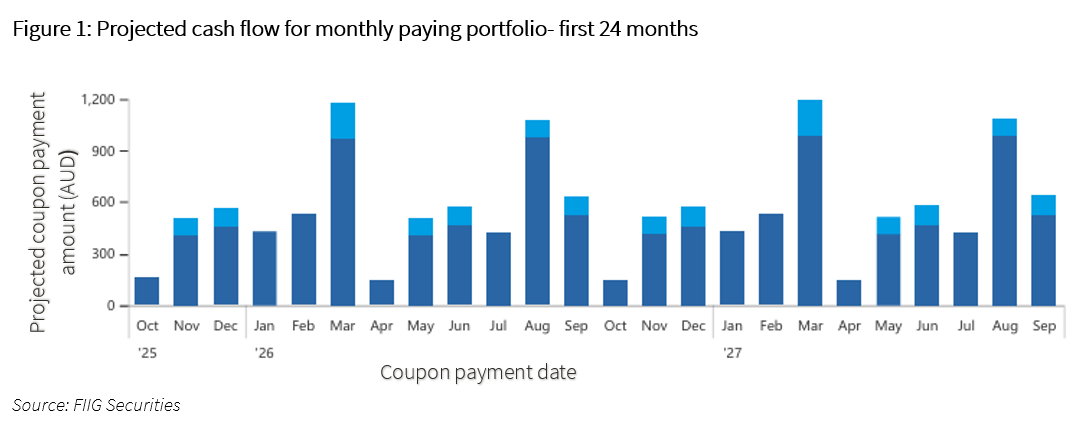
Since bonds have different payment dates and schedules, bond investors have the ability to customise the frequency of the income stream. Fixed rate bonds typically pay semi-annually, while floating rate note bonds pay quarterly and Residential Mortgage Backed Securities (RMBS) pay monthly. As such, a regular income stream can be tailored to meet monthly fixed expenses and budgeting needs, and so can replace the income stream paid via rental income.
The chart below shows a bond portfolio, for illustrative purposes only, that has been constructed to achieve a monthly income stream. For simplicity, only the first 24 months of cash flow projections is shown, and the portfolio has been constructed with an initial cash outlay of around AUD100,611. As such, to achieve an increased monthly income stream, then the original cash outlay can be further increased.
Property-exposure without the maintenance
At present, house prices are experiencing a downturn, as a result of a rise in interest rates, the changes to the taxation treatment of property and the prolonged rise in property prices prior to this (where wages have not been keeping pace). According to the Cotality Home Value Index for September, national dwelling values are now 5.2% below their March 2026 peak. Investors seeking to achieve an exposure to the property market but without the exposure to property price movements or the maintenance hassle can do so through bonds.
Through purchasing bonds in the property sector, an investor can obtain a property exposure but without the maintenance involved through owning a property directly. There is an array of different types of bonds that provide a property exposure:
- Australian Real Estate Investment Trust (REIT) bonds- which are companies that own, operate and finance income producing real estate, such as apartments, office buildings, shopping centres, data centres, logistics warehouses, social infrastructure (daycares, medical centres etc), where the coupon payments are made up of the rent received from these types of properties. This diverse range of real estate assets can be counter-cyclical to residential property price moves. FIIG provides investors access to bonds in the REIT sector issued by Scentre Group, Dexus, Mirvac, and Charter Hall, among others.
- RMBS bonds- are bonds backed by pools of residential mortgages, providing investors with cashflows from the borrowers’ mortgage repayments. While mortgages are exposed to property prices, however it is a secondary exposure to RMBS bonds. This is because when a mortgage is functioning properly the price of the underlying asset shouldn’t affect the mortgage. The primary mechanism for the repayment is that the mortgage is simply paid on a monthly/fortnightly basis out of the borrower’s income. Therefore, the price of the underlying asset only matters in a secondary way. FIIG provides investors access to bonds issued by the RMBS programs of the major banks as well as other mortgage lenders including ANZ Kingfisher, Macquarie PUMA, CBA Medallion, Pepper Money and Liberty Financial, among others.
Conclusion
Bonds provide a regular steady cash flow and at attractive higher returns, which appeal to investors who are seeking an alternative income solution following key changes following the 2026-27 Federal Budget. Another key benefit of bonds is that the original investment amount is returned at the maturity date, which may not be the case across other asset classes in comparison. There is a wide array of bonds that provide investors with an exposure to the property sector, but providing better diversification, less exposure to property price moves and without the maintenance headache that direct property ownership can impose.