Volatility creates opportunity. Long dated USD government and corporate bonds offer some outstanding opportunities

US 30 year bonds are currently trading at an unusually high spread to US 10 year bonds. Translation, investors are being paid an unusually high premium for investing in 30 year bonds over 10 year bonds. This is one of the types of opportunities that can arise from sudden market corrections like the one that is currently occurring on global equity markets.
Strategic implications:
- Look for opportunities to buy long dated bonds in USD while markets are adjusting their long term expectations
- AUD above 70c also creates good opportunity to set positions
- Particularly suitable for investors looking for hedge against falling equity markets, China hard landing or Australian recession.
To understand this strategy, we need to start with how it came about:
- Global markets started to come to the realisation that the world economy would not grow as fast as they had thought and had priced in.
- As a result, equity markets corrected sharply downwards in January.
- Similarly, 10 year government bond prices have climbed suddenly. When bond prices rise, yields fall. Simply, investors selling out of equities look to invest in government bonds as something safer, and when the demand for the bonds rise, like any investment, so does the price.
- During this correction, US 10 year bond benchmarks (ie the US 10 year Treasury Note yield) fell by 31bps. Curiously however 30 year bonds fell only 22bps.
- This might seem insignificant. However, it is the fact that the “spread” got bigger by 9bp when it should have got smaller that highlights the opportunity for investors.
- The difference between two yields is known as the spread. The spread between the 10 year and 30 year benchmarks in the US has averaged 57bps over the past 30 years. More importantly, when recessionary fears are rising, this spread typically falls sharply. So when the spread got bigger, it flags either a market dislocation, that is an opportunity to profit.
The chart below, while very busy, shows that this spread typically moves with the cash rate (“Fed Rate”). When the Fed Rate is falling, the 10 year bond yield falls. But markets assume that the Fed Rate will return to average levels eventually, so the longer term 30 year bond yield doesn’t fall as much. This is shown most recently when the Fed put its funds rate to 0.12%. Markets expected the economy to return to normal and so they left the 30 year bond yield much higher than the 10 year yield. This spread increased to 150bps for the first time on record. Then as each year passed and the global economy did not return to normal, markets adjusted their growth expectations, and the spread slowly came back down and briefly returned to long term average levels.
However, in the past four weeks, despite the market’s realisation of the risk of a long term global slowdown, the spread increased rather than reduced.
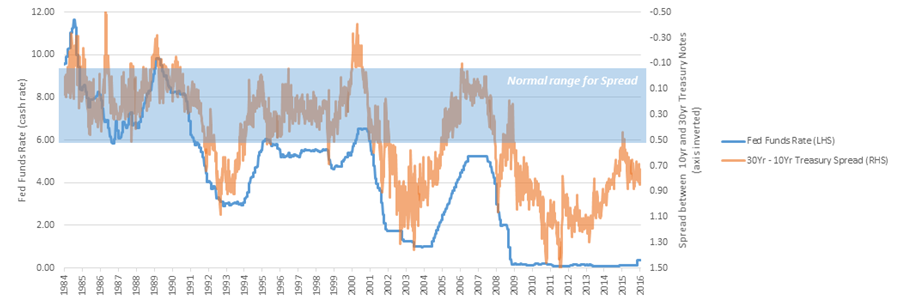
In very simple and much shorter terms, the current spread of 83bps is far too high. For investors looking to take a long term position in USD, this represents an opportunity to buy bonds of very long duration. Markets will eventually price in a smaller spread, and then 30 year bond yields will fall at least to the long term average, but likely a spread of 30-40bps. This leaves 50bps pa of additional income investors can earn today by taking advantage of this temporarily high spread.
If the low returns on USD government bonds don’t appeal, you can take advantage of long dated USD corporate bonds such as:
- Newcrest 2041s with a yield to maturity of around 7.75% per annum
- Newcastle Coal Infrastructure Group (NCIG) with a yield to call of 10.35% per annum
For more information please call your local dealer.
Note: Rates are accurate as at 2 February 2016 but subject to change.