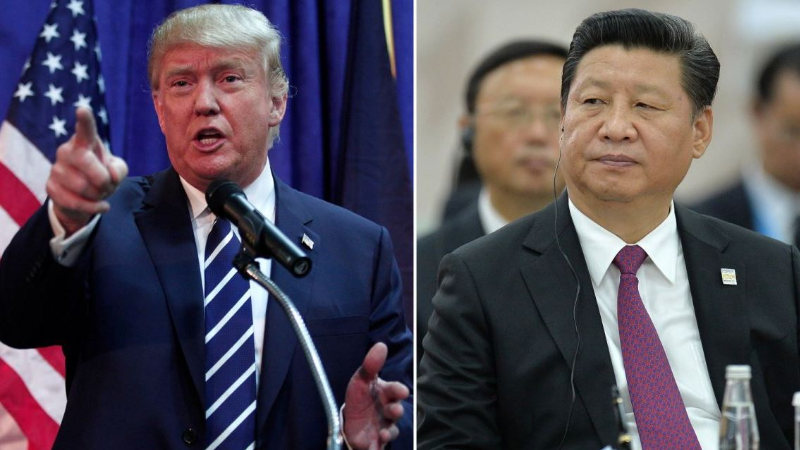
Before the election, Trump talked tough on tackling China’s “trade abuses”. Since then he has been relatively tame. That is until last Friday when he signed Executive Orders aimed at foreign trade abuses, albeit not country specific. That is just a week ahead of his first face to face meeting with China’s President
China needs trade surplus to rise; Trump promised trade deficit would shrink
These goals are not compatible. China is the source of more than half of the US trade deficit.
China needs to increase its trade surplus to achieve its GDP growth targets, which in turn are needed to avoid the risk of social unrest linked to rising unemployment. Without a higher trade surplus, China needs to continue to stimulate its economy with debt. Corporate debt has escalated rapidly in the past few months, particularly in the state owned steel and property sectors. While China has been raising official interest rates, the lending costs have been falling as state owned banks lower margins to meet Beijing’s demand for more lending.
In the meantime, Trump needs a win. Immigration bans have failed. Obamacare remains intact. Tax changes are some months away. And the attention on his alleged relationship with Russia is well out of his control. So a headline win on the trade front, particularly with the Chinese who are blamed for so much of the US manufacturing job losses, would be a welcome distraction.
Trump on the losing side of the principles of global trade and logic
Global trade works on the basis of shifting labour intensive industries to lower cost of labour countries. In the late 1800s, that was the United States. Now it’s China. Without putting up trade barriers, that is, without directly turning on the core principles of free global trade, Trump can do little to prevent this. And so, that would appear to be the path he will head down. In fact, it now looks like the only way that he will get his corporate tax cuts through the divided Republican Party is to enforce border taxes on products, aka tariffs.
The Chinese know this and have been taking the high ground. Their public announcements, unlike Trump’s, remain emotionless and logical. Including arguments about high tech services, where China runs a deficit with the US so there needs to be a total trade discussion, not just one on products.
Trump needs to follow through on his anti-globalisation promises, or lose face
Other than some pre-inauguration tweets, Trump has been relatively silent on trade and China since the election. But that’s changed in the past few days with tweets saying “the theft of American prosperity will end” and “thousands of factories have been stolen from our country”.
There is little doubt this has been timed to build up to the meeting on Friday (US time) with Chinese President Xi Jinping. Trump’s commerce secretary and director of the National Trade Council both tried to play down suggestions that Trump’s Executive Orders were aimed at the Chinese. But these denials were undermined again by Trump tweets stating that the meeting with Xi would be “a very difficult one” and “We can no longer have massive trade deficits and job losses. American companies must be prepared to look for other alternatives”.
US Trade Representative report accuses China of dumping steel, again
If the tweets weren’t bad enough, the USTR, a part of the office of the President, released its 2017 report last week. The report says that while China has taken steps to reduce overcapacity, complaints of dumping were no better than in the previous report (issued by the Obama administration).
The report specifically called out the use of Chinese government financial support for industries such as steel, as being the cause of the “flood of exports” and the distortion of global markets.
Problem for the Chinese is that Trump’s office has a point
China’s headline economic growth remains in line with targets. Official manufacturing figures show the industrial sector growing again. The problem is that when one looks at non government economic data, such as the Caixin PMI which has a higher proportion of private sector manufacturers or the China Beige Book, similarly private sector weighted, a stark difference between public and private sector growth is obvious. Job growth in the private sector is at its lowest point for four years, while official PMI data is at a 15 month high. Similarly capital spending by the private sector is 40% down in the past two years.
But the more the private sector slows, the more the Chinese government increases pressure on banks to lend more and local governments to borrow more. This might pay off if it can stimulate growth overall, including the private sector, but every month that goes past without a clear turnaround in the private sector is another month away from the economic transition China needs and another month of Beijing being forced to maintain growth by stimulating old industries like steel manufacturing, making US trade concerns even worse.
Conclusion
Watch for the fireworks this Friday (Saturday our time). China needs to maintain its surplus if not increase it. Trump needs a win and Chinese steel dumping looks like an easy target. Maybe this isn’t the end of the battle, but the downside risk for Chinese steel and therefore for the price of iron ore certainly outweighs the upside.