Portfolio allocation needs change over time. Do you still need a big house for your children? Do you want to move to be closer to family? Has your spending declined or increased? Have your retirement goals changed?
With the volatility in markets this year we have been reassessing our thoughts about asset allocation and what it should look like in an income generating pension style portfolio.
Do you chug along each year with the same goals and asset allocation, or do you reassess your needs and consider changing financial markets?
After the last financial year has been put to bed is a good time to review your portfolio and determine if it is still fit for purpose. Typically, investors have hit ‘peak wealth’ about eight years before retiring to five years after, in which period it is time to think about being more defensive. You simply won’t have the time to recover from a major disruption like the GFC unless you decide to postpone retirement or go back to work, if that’s still possible.
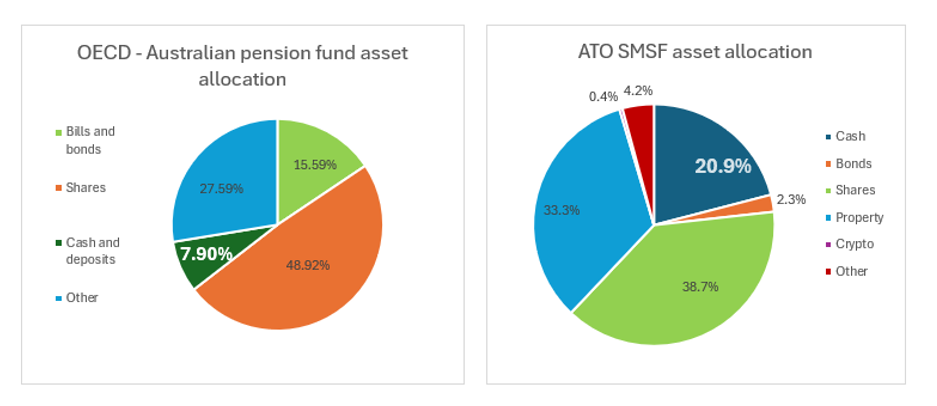
Asset allocation for SMSFs and even for large Australian pension funds is skewed towards equity risk assets (shares and property) and cash – see the charts below.
Australian pension fund asset allocation
Source: OECD Pensions at a Glance 2025, and ATO SMSF 2026.
Both groups have a high cash allocation – incredibly high in SMSFs - and a very low allocation to bonds. The average allocation to bills and bonds from pension funds across 34 countries was 40%. Australian pension fund allocation is the 6th lowest of the list at 15.6%, which is an improvement since the last time we looked in 2018, but still desperately underweight by international standards.
We think that’s because many don’t appreciate the defensive qualities or range of bonds available.
Defensive qualities of bonds
Both government and investment grade corporate bonds are considered low risk defensive assets. They have known maturity dates where investors can expect to be repaid the bond’s face value, usually $100. Interest income is also known and cannot be cut unlike hybrids or dividends.
Importantly, bond interest payments and return of capital at maturity are legal obligations, making them lower risk than hybrids, where interest can be forgone and shares, where there is no obligation to pay a dividend and no maturity date where capital must be returned to the investor.
Huge range of bonds available
In the over-the-counter global bond market, there are thousands and thousands of bonds available. They range from the lowest risk government bonds to high risk, high yield corporate bonds and of course, bonds are available in foreign currencies. Current returns range from 4% per annum through to equity like returns of 10% or more per annum.
Bonds are an old and very common form of finance. Did you know 30 of the ASX Top 50 listed companies issue bonds? Or that those companies issue in more than 10 different currencies?
If you haven’t heard of bonds before it’s because historically in Australia, they’ve been traded in minimum $500,000 parcels, only really available to large institutions and ultra-high net worth individuals.
At FIIG Securities we make over 1,000 bonds available from just $10,000 per bond with a minimum upfront investment of $50,000.
SMSFs hold too much cash
SMSFs with 21% of their portfolio sitting in lower yielding cash would do well to investigate corporate bonds in particular as a low-risk investment grade portfolio will pay 1 – 2%p.a. more than cash throughout the economic cycle.
At the moment a very good deposit rate is about 5.0%p.a. so a low-risk bond portfolio would earn 6.0%p.a. to 7.0%p.a. and would really serve to boost cashflow over time. The increase doesn’t look big, but on an investment of $500,000, the deposit would earn $25,000, compared to a bond portfolio with a 6.5%pa yield which would earn ~$32,500 or $7,500 more each year. That could make a big difference to your finances.
A high cash allocation not only drags overall returns, but if you have a specific target yield in mind, it means you have to take additional risk with the other 89% of your portfolio to meet expectations.
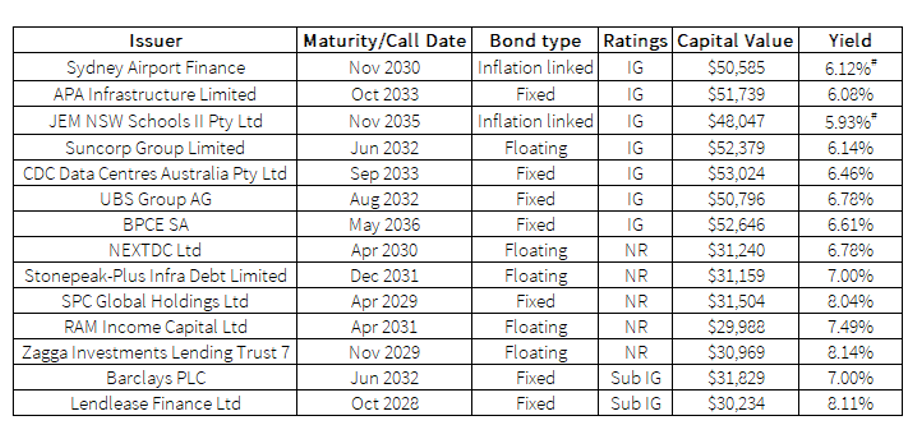
To demonstrate, below is a sample Balanced bond portfolio. Its weighted average yield to maturity is 6.91% p.a. A total of 62% is allocated to low-risk investment grade bonds, and the remaining 38% to higher yield bonds to boost overall returns. The high yield bonds all have lower allocations per bond of around $30,000, compared to investment grade options with circa $50,000 each.
Sample Balanced bond portfolio
Source: FIIG Securities
Note: Prices accurate as at 01 August but subject to change
# Assumes 2.5%pa inflation assumption
Minimum investment per bond is $10,000 and minimum upfront investment of $50,000
We’ve chosen to invest in all three types of bonds – fixed, floating and inflation linked - to provide protection no matter what the economic environment. There are also a range of maturity dates. Bonds are expected to mature on a regular basis over the next 7 years, providing natural liquidity.
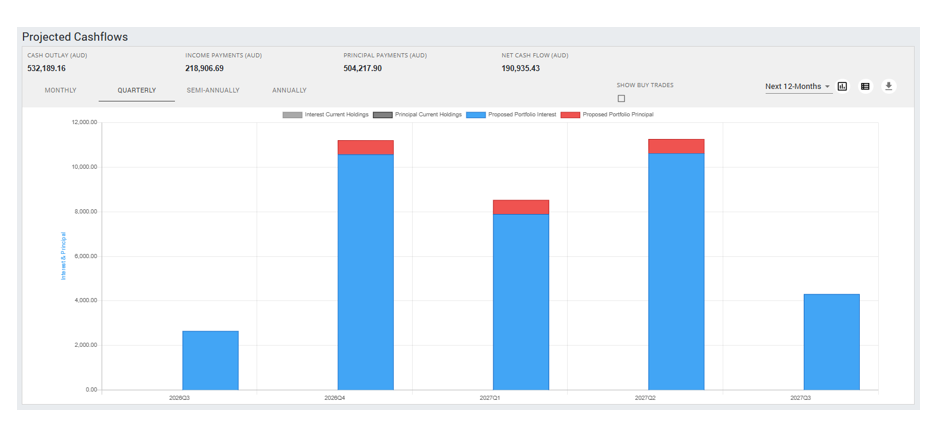
See the table below for expected cashflow in the coming year.
Sample bond cashflow
Source: FIIG Securities
You can see there is a mixture of interest and capital being paid in the next 12 months, with the split being approx. $36,000 interest and $2,000 capital.
The capital can be reinvested or spent as required, but nonetheless an income of 6.77% for the next year looks very attractive.
The level of risk can be dialled up or down depending on investor preference, with a resulting lower or higher yield respectively.